
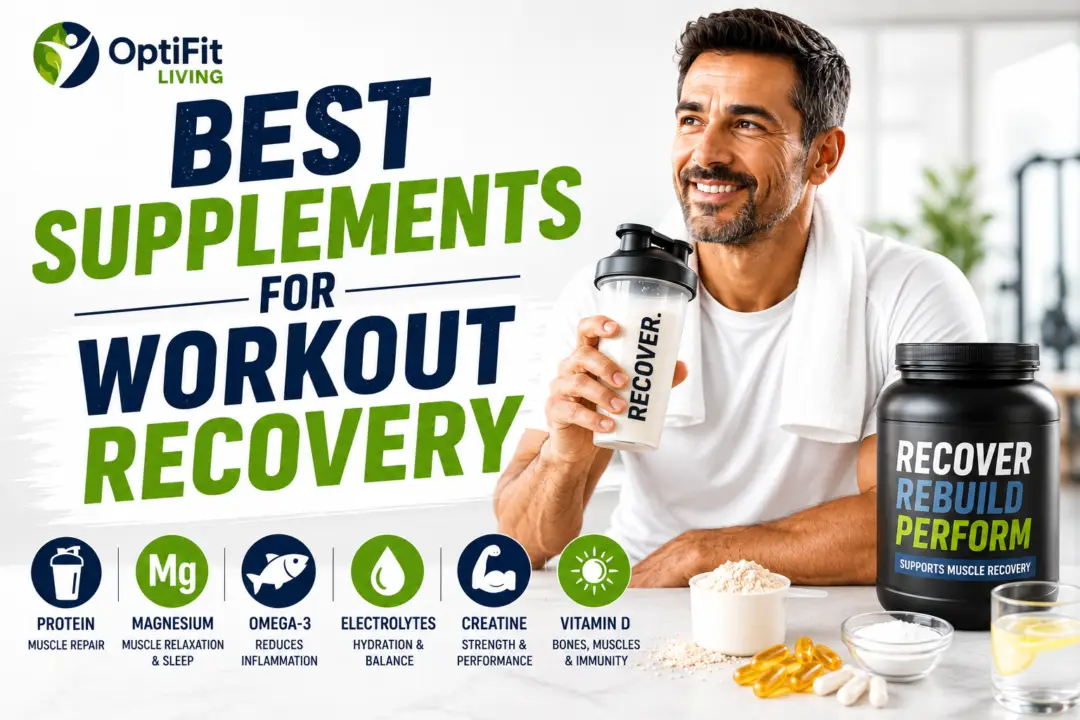
The best supplements for workout recovery are the ones with real evidence behind them, and that list is short. Protein and creatine monohydrate have the strongest support from sports nutrition research. Vitamin D, magnesium and omega-3 help mainly if your diet falls short, and caffeine helps performance more than recovery. Sleep, food and rest days still do most of the work.
This guide goes through each supplement, what the sources say, the amounts they mention and the cautions that matter for men over 40. It is general information, not medical advice. Talk to your doctor before adding a supplement, especially if you have kidney disease, heart disease, diabetes or take regular medicines.
Why you can trust this guide
- Source order. We used position statements from the International Society of Sports Nutrition (ISSN), the FDA and NIH-based figures first. Where we could only reach secondary sources, we say so.
- No product pushing. We do not name brands or sell anything, and we do not claim a pill will “boost” or “repair” muscle.
- Gaps we could not close. We could not open the NIH fact sheets directly, so a few figures (vitamin D and magnesium limits) come from pages that quote them. We mark those. We also did not find strong evidence that omega-3 speeds up soreness recovery.
- Last checked: October 24, 2026.
What recovery actually means
Recovery is how your body repairs muscle, refills energy stores and gets ready for the next workout. Several things control it: how much you sleep, how much protein and total food you eat, how hard you trained, and how many rest days you take. Supplements sit on top of those basics and cannot replace them.
The CDC says adults aged 18 to 60 need at least 7 hours of sleep a night. If you are short on sleep, no supplement will fix it. Read how sleep affects testosterone levels for more on why this matters for men over 40. Think of the best supplements for workout recovery as small add-ons to these basics.
Best supplements for workout recovery at a glance
Use this table as a quick summary. The sections below explain each row. This table ranks the best supplements for workout recovery by how strong the evidence is.
| Supplement | What the evidence supports | Amount mentioned in sources | Main caution |
|---|---|---|---|
| Protein (whey or food) | Supports muscle repair and growth with training | 0.25 g per kg, or 20 to 40 g, per serving | Count it with food; kidney disease needs advice |
| Creatine monohydrate | Raises high-intensity exercise capacity and lean mass | 3 to 5 g a day is the usual range | Water weight; check with a doctor if you have kidney problems |
| Vitamin D | Fixes a shortage; not a recovery booster by itself | RDA 600 IU (15 mcg) at ages 19 to 70 | Upper limit about 4,000 IU a day |
| Magnesium | Helps if intake is low; evidence for recovery is limited | RDA 420 mg for men, from food and supplements | Supplement limit 350 mg; can cause diarrhea |
| Omega-3 (fish oil) | General health; recovery evidence is limited | No single standard; EFSA saw no concern up to 5 g a day | Can interact with blood thinners |
| Caffeine | Helps performance and feeling of effort | FDA cites 400 mg a day for most adults | Can hurt sleep, which hurts recovery |
1. Protein: the most useful recovery nutrient
Muscle is built from protein, and training breaks it down a little each session. The ISSN’s 2017 position stand says most people who exercise do well on 1.4 to 2.0 grams of protein per kilogram of body weight per day. It suggests about 0.25 grams per kilogram, or 20 to 40 grams, in each serving, spread across the day about every 3 to 4 hours. It also says taking protein before or after a workout both work.

Here is what that means in real numbers. A man who weighs 80 kilograms (about 176 pounds) would aim for roughly 112 to 160 grams a day, with about 20 grams or more in each meal. Whey powder is a convenient way to fill gaps, but eggs, fish, chicken, yogurt, beans and milk do the same job. Check with a doctor first if you have kidney disease, because some people with it need to limit protein.
2. Creatine monohydrate: the best-studied supplement
The ISSN’s 2017 position stand says creatine monohydrate is the most effective supplement available for raising high-intensity exercise capacity and lean body mass during training. It also reports no compelling evidence of harm in healthy people, including in long-term use. Most sports sources describe a maintenance dose of 3 to 5 grams a day.
Common side effects are mild. Some people gain a little water weight in the first weeks, and very large single doses can upset the stomach. Creatine can also raise a blood test marker called creatinine, which doctors use to estimate kidney function, without meaning there is kidney damage. Tell your doctor you take it before any blood test. If you have kidney disease, diabetes or high blood pressure, get medical advice first. Creatine is the one supplement that makes almost every list of the best supplements for workout recovery and performance.
3. Vitamin D: fix a shortage, do not megadose
Vitamin D matters for bones and muscles, but taking extra when your level is normal does not make you recover faster. The NIH recommended daily amount is 600 IU (15 mcg) for adults aged 19 to 70 and 800 IU (20 mcg) from age 71. The upper limit is generally given as 4,000 IU (100 mcg) a day for adults. A simple blood test can show whether you are low. If you live in a cold area or spend most days indoors, ask your doctor to check it.
4. Magnesium: helpful when your diet is low
Magnesium takes part in muscle and nerve function. The NIH-based figures we found list an RDA of 420 milligrams a day for men over 30, counting food and supplements together, and a limit of 350 milligrams from supplements and medicines. Going over that limit often causes loose stools and cramps. The evidence for magnesium speeding recovery is limited, so food comes first: seeds, nuts, beans, whole grains and leafy greens. Our full guide covers magnesium benefits for sleep and muscle recovery in more detail. Magnesium is on many lists of the best supplements for workout recovery, but food usually covers it.
5. Omega-3 fish oil: good for general health
Omega-3 fats from fish or fish oil support heart and general health. We did not find strong evidence in our check that they speed up recovery after workouts. The European Food Safety Authority concluded in 2012 that supplements of up to 5 grams a day of long-chain omega-3 raise no safety concerns for adults, but that is a safety statement, not a recovery claim. People who take blood thinners should talk to a doctor first. Eating fatty fish such as salmon twice a week is a simple alternative.
6. Caffeine: a performance helper, not a recovery aid
Caffeine can make a workout feel easier, which helps you train harder. The FDA cites 400 milligrams a day, about two to three 12-ounce cups of coffee, as an amount most healthy adults can have without bad effects. People differ a lot in how they react. If caffeine late in the day hurts your sleep, it works against recovery, so keep it to the morning and early afternoon.
7. Electrolytes and hydration
You lose water and salt in sweat. For most workouts under an hour, water and normal meals are enough. If you sweat heavily or train for long periods in heat, an electrolyte drink can help, but check the label for sugar and sodium. People with high blood pressure or heart conditions should ask their doctor how much sodium is safe for them. Electrolytes are the last of the best supplements for workout recovery that matter only in special cases.
8. Food first
A good recovery meal has protein, carbohydrates and vegetables. Think eggs with oats and berries, salmon with rice and greens, or chicken with beans and salad. Real food gives you protein plus vitamins and minerals that no single pill supplies. Our guide on how to build muscle over 40 has meal ideas.

Rest days and soreness
Some muscle soreness is normal when you start a new routine. It usually peaks a day or two after the workout and fades after that. Sharp pain, joint pain or soreness that lasts more than a few days is different, and it is a reason to rest and ask a doctor.
The CDC asks adults to do muscle-strengthening work on at least two days a week. That leaves plenty of room for rest days. Do not train the same muscle groups on back-to-back days. A walk on a rest day keeps you moving and helps you feel looser. No supplement can replace a rest day.
A simple way to start
Add one thing at a time, so you can tell which of the best supplements for workout recovery is working. Here is an order that makes sense for most men.
- Weeks 1 and 2: fix sleep and food. Aim for 7 or more hours and a protein serving at each meal.
- Week 3: if you still fall short on protein, add a protein shake to fill the gap.
- Week 4: if you want to try creatine, add 3 to 5 grams a day after checking with your doctor.
- Later: ask for a blood test if you suspect low vitamin D or other gaps, and add only what the results support.
Keep a short log. Write down your sleep, your workouts and how you feel. If a new supplement causes stomach upset, poor sleep or any odd symptom, stop it and ask your doctor. Add the best supplements for workout recovery one at a time, in this order.
Common mistakes to avoid
The first mistake is buying a long list of products at once. You cannot tell what helps, and the cost adds up. The second is taking more than the label says because you want faster results. More is not better, and some products have upper limits. The third is skipping sleep and relying on caffeine. The fourth is believing ads that promise to “repair” or “rebuild” muscle in days. No supplement does that. A clear plan, steady training and enough rest do more than any bottle. Buying every one of the best supplements for workout recovery at once is the most common mistake.
When to talk to a doctor first
Ask a doctor or pharmacist before you start supplements if you are over 40 and have kidney, liver or heart disease, diabetes, high blood pressure, or if you take blood thinners or other regular medicines. Also check in if you feel unusually tired, because the cause may be something a supplement will not fix.
 Even the best supplements for workout recovery vary in quality, so check the label.
How to pick a safer supplement
- Read the label for the exact amount of each ingredient. Avoid “proprietary blends” that hide the doses.
- Look for products tested by an independent group, such as NSF Certified for Sport or Informed Sport. These marks show the product was checked for what the label says.
- Remember that dietary supplements are not approved by the FDA before they are sold, so quality varies.
- Start with one product at a time, so you can tell what helps and what causes problems.
- Skip anything that promises fast muscle gain or a “miracle” recovery.
A simple recovery routine
This table shows how the basics fit into a normal day for an 80 kilogram man who trains in the evening. It is an example, not a prescription.
| Time | What to do | Why |
|---|---|---|
| Morning | Breakfast with 20 to 30 g of protein; coffee if you like it | Starts the day’s protein spread |
| Midday | Meal with protein and vegetables; water | Keeps total intake on track |
| Before training | Light carbs; water | Fuel for the session |
| After training | Meal or shake with 20 to 40 g of protein | Supports repair after the session |
| Evening | Dinner with protein; no caffeine | Helps sleep |
| Night | 7 or more hours of sleep | Most recovery happens here |
Questions people ask
What is the best supplement for workout recovery?
Protein has the clearest support, because muscle repair needs it. Creatine monohydrate is the best-studied supplement for training performance. Neither replaces sleep and food.
Do men over 40 need supplements to recover?
Not always. Many men can meet their needs with food, so the best supplements for workout recovery are optional. Supplements make most sense when your diet or a blood test shows a gap.
Is creatine safe to take every day?
The ISSN found no compelling evidence of harm in healthy people. If you have kidney problems or take regular medicines, ask your doctor first.
How much protein do I need after a workout?
The ISSN suggests about 0.25 grams per kilogram of body weight, or 20 to 40 grams, per serving, and says both before and after training can work.
Sources used
The main sources are the ISSN position stand on protein and exercise (2017), the ISSN position stand on creatine (Kreider et al., J Int Soc Sports Nutr 2017), the FDA’s caffeine guidance, the NIH Office of Dietary Supplements figures for vitamin D and magnesium (read through quoting pages), an EFSA opinion on omega-3, and the CDC’s sleep guidance. Last checked on October 24, 2026.