
To stay strong and active after 40, you need three things every week: strength work on at least two days, regular moderate activity such as brisk walking, and some balance practice. Add enough protein, enough sleep and a habit you can keep, and most of the rest takes care of itself. This guide explains each part with numbers from public health sources, then gives you a simple week to follow.
A quick note on what this is. It is general information based on CDC guidelines and published research, not medical advice, and it is not written from personal training experience. If you have heart disease, diabetes, joint pain or you have been inactive for years, talk to your doctor before you start.
Why it takes more effort to stay strong and active after 40
Muscle does not disappear overnight, but it does fade slowly if you do not use it. Several sources put the loss at about 3 to 8 percent per decade after age 30, with the decline faster in inactive people and after 60. Treat that range as a rough estimate, because studies differ. What they agree on is the direction: less muscle means less strength, slower walking and a higher risk of falls later in life.
The good news is that muscle responds to training at any age. You do not need heavy weights or long workouts. You need regular, progressive effort, which means doing a little more over time.
What the CDC says you need to stay strong and active after 40
The CDC’s guidelines for adults, which also apply to older adults, are simple. They are easy to track with a checklist.
| Type of activity | Weekly target | Easy way to do it |
|---|---|---|
| Moderate aerobic activity | At least 150 minutes | 30 minutes a day, 5 days a week |
| Or vigorous aerobic activity | At least 75 minutes | Short runs or hard cycling, 3 to 4 days |
| Muscle strengthening | At least 2 days | Two 20 to 30 minute sessions |
| Balance activities | Included for older adults | A few minutes after brushing your teeth |
You can mix moderate and vigorous activity, and you can break the time into short blocks. The CDC adds that some physical activity is better than none, so a smaller start is still worth it.
Build strength: the part most men skip
Strength training is the piece that protects muscle, so start there. The CDC asks for at least two days a week, working all the big muscle groups: legs, hips, back, belly, chest, shoulders and arms.

You do not need a gym. A single pair of dumbbells, a resistance band or your own body weight is enough to begin. Here are five moves that cover most of the body.
- Goblet squat: hold one dumbbell at your chest and sit back and down, then stand tall. It trains thighs, hips and core.
- Push-up (wall, counter or floor): chest, shoulders and arms. Start on a wall or counter if the floor is too hard.
- One-arm row: hinge forward, pull a dumbbell toward your hip. It works your back and the backs of your shoulders.
- Glute bridge: lie on your back and lift your hips. It protects your lower back and builds hip strength.
- Plank or incline plank: hold a straight line from head to heels for 15 to 30 seconds.
Start with one set of 8 to 12 repeats per move and add a second set after two weeks. Pick a weight that makes the last two repeats feel hard but not shaky, and keep your form clean. For a full beginner routine, see our strength training plan for men over 40. The goal is simple: use your muscles on purpose twice a week so you can stay strong and active after 40.
Stay active every day, not just on workout days
A 30-minute workout does not cancel eight hours in a chair. Daily movement matters, and brisk walking is the easiest way to get it. The CDC counts brisk walking as moderate activity, so five 30-minute walks add up to the 150-minute target.

If you are short on time, use short blocks. Ten minutes after each meal is enough to build a habit. Park farther away, take the stairs and stand up for a minute every hour at work. None of these feels like exercise, but they add up. Daily movement is the cheapest way to stay strong and active after 40.
Practice balance before you need it
The CDC lists balance activities as part of the weekly plan for older adults. You do not have to be 65 to start. Balance is a skill that fades if you ignore it, and a few minutes a day is all it takes.
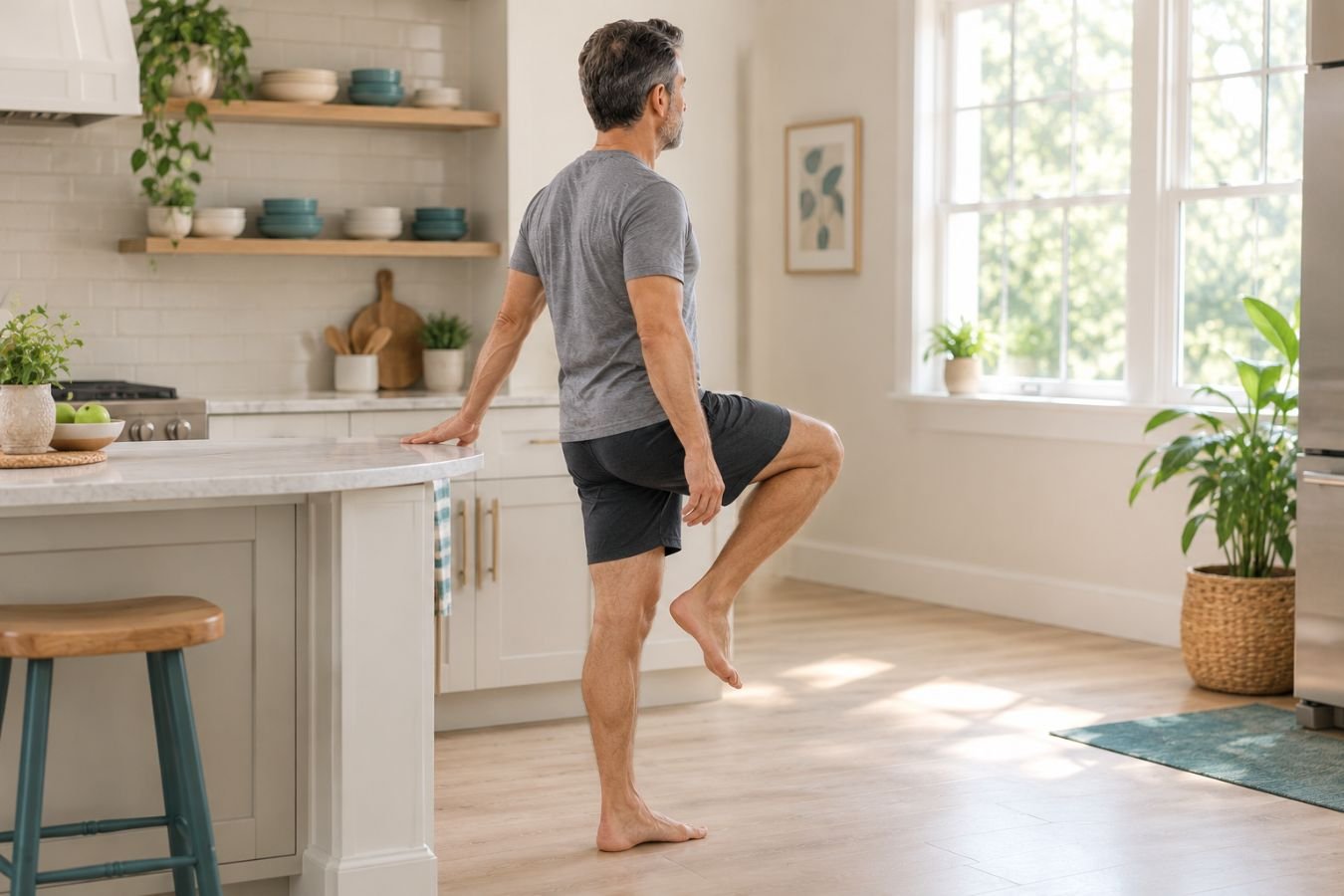
Try this: stand next to a counter and lift one foot an inch off the floor. Hold for 20 seconds, then switch legs. Keep one hand near the counter in case you wobble. When that feels easy, do it without touching the counter, then try it with your eyes on a spot on the wall. Stop if you feel dizzy or unstable. Balance work helps you stay strong and active after 40 because it protects you from falls.
Eat enough protein to support your muscles
Protein supplies the building blocks for muscle repair. The standard recommended dietary allowance for adults is 0.8 grams per kilogram of body weight per day. A 2013 expert group called PROT-AGE argued that this is too low for older adults and suggested at least 1.0 to 1.2 grams per kilogram for people over 65. Active older adults may need 1.2 grams or more.
Here is what that looks like for a man who weighs 80 kilograms, about 176 pounds. At 0.8 grams per kilogram, that is 64 grams a day. At 1.2 grams per kilogram, it is 96 grams. The PROT-AGE advice is aimed at people over 65, so for men in their 40s and 50s it is a reference point, not a rule. A doctor or dietitian can help you pick a target, and anyone with severe kidney disease should check first, because some people with kidney problems need to limit protein.
Good food sources include eggs, fish, chicken, Greek yogurt, beans, lentils and milk. Spreading protein across meals is easier than eating it all at dinner. Our post on how to build muscle over 40 covers meals in more detail. Food is part of how you stay strong and active after 40, not an extra.
Protect your sleep and recovery
You get stronger while you recover, not while you lift. The CDC says adults aged 18 to 60 need 7 or more hours of sleep a night. For ages 61 to 64 the range is 7 to 9 hours, and for 65 and older it is 7 to 8 hours. Poor sleep makes workouts feel harder and can leave you more sore. If you want to know why sleep matters for hormones too, read how sleep affects testosterone levels.
Recovery also means rest days. Do not train the same muscles on back-to-back days. A walk on a rest day is fine, and it helps you feel looser. Rest is how you keep progress, so it belongs in any plan to stay strong and active after 40.
A simple week to follow
This plan uses the CDC targets and fits into a normal work week. Adjust the days to match your schedule.
| Day | What to do | Time |
|---|---|---|
| Monday | Strength: squat, push-up, row, bridge, plank | 25 minutes |
| Tuesday | Brisk walk plus 2 minutes of balance practice | 30 minutes |
| Wednesday | Rest, or an easy stroll | 10 to 20 minutes |
| Thursday | Strength: same five moves, add a set if it feels easy | 25 minutes |
| Friday | Brisk walk or bike ride | 30 minutes |
| Saturday | Longer walk or a sport you enjoy | 40 to 60 minutes |
| Sunday | Rest, with light stretching | 10 minutes |
This week adds up to about 135 to 165 minutes of walking and other activity plus two strength days. Together with short walks on other days, that meets the CDC targets. Our guide on how much exercise per week explains the totals in more detail. Use this layout as a starting point to stay strong and active after 40, then adapt it.
Warm up and cool down in five minutes
A short warm-up raises your heart rate slowly and loosens your joints. The National Institute on Aging’s home routine begins with a warm-up and ends with stretching, and the same shape works for any session.
- March in place for one minute, lifting your knees to a comfortable height.
- Roll your shoulders backward ten times, then forward ten times.
- Do ten slow hip circles with your hands on your hips.
- Do eight shallow squats to a chair.
After the workout, walk slowly for a minute and stretch your calves, thighs and chest for 20 to 30 seconds each. You should feel a pull, never a sharp pain.
How to make the workouts harder without getting hurt
Strength grows when your muscles face a little more than they did last time. Doctors and trainers call this progressive overload. The easiest way to apply it is the “two extra repeats” rule. When you can complete all your sets with clean form and still have two repeats left, add one repeat. When you reach 12 repeats on every set, move up to the next small weight, usually 2 to 5 pounds, and drop back to 8 repeats.
Change only one thing at a time. If you add weight, keep the repeats the same. If you add a set, keep the weight the same. Slow movement helps too. Take two seconds to lift and three to lower, and breathe out on the effort. The NIA booklet also advises keeping your joints slightly bent rather than locked and avoiding jerky motions.
Know when to stop
Mild muscle soreness for a day or two is normal. Some symptoms are not. Stop and get medical help if you have chest pain, trouble breathing or dizziness during exercise. Joint pain that lasts more than a few days is also worth a visit. A doctor or physical therapist can check whether you need a different move or a different plan.
Clear your exercise area of rugs and cords, wear shoes with a firm sole, and drink water before and after. These steps are simple, but they prevent many common home injuries.
Common mistakes to avoid
The first is doing too much too soon, which leads to sore joints and quitting. The second is skipping the warm-up. Five minutes of easy movement, such as marching in place and shoulder rolls, prepares your joints. The third is lifting heavy with poor form. Pick a lighter weight and move slowly. The fourth is ignoring pain. Soreness a day or two after training is normal. Sharp or joint pain is not, and it is a reason to stop and get advice.
How to keep going
Consistency beats intensity. Put your workouts in your calendar like a meeting, and keep the first month easy. Write down what you did, even one line. Check your progress every two weeks with simple tests, such as how many chair squats you can do in 30 seconds or how long you can hold a plank. Small gains show up sooner than changes in the mirror, and they help you keep going. If you are just starting, our home workout without equipment for beginners is a gentle first step. Habits, not willpower, are what let you stay strong and active after 40 for years.
Questions people ask
How can men stay active after 40?
To stay strong and active after 40, aim for about 150 minutes of moderate activity a week, such as brisk walking, plus muscle-strengthening on two days. Add short bursts of movement through the day.
Is strength training important after 40?
Yes. Muscle mass slowly declines with age if it is not trained, and strength work is the best way to slow that. The CDC recommends it on at least two days a week.
How much protein do men over 40 need?
The standard allowance is 0.8 grams per kilogram per day. Some expert groups suggest 1.0 to 1.2 grams per kilogram for people over 65. Ask a doctor or dietitian what is right for you.
How many hours of sleep do I need?
The CDC says 7 or more hours for adults aged 18 to 60, and 7 to 9 hours for ages 61 to 64.
Can men build muscle after 40?
Yes, and you can still stay strong and active after 40 by training gradually. Muscle responds to training at any age, as long as the effort increases gradually and you recover well.
Main reference for this guide: CDC physical activity guidelines for adults.