
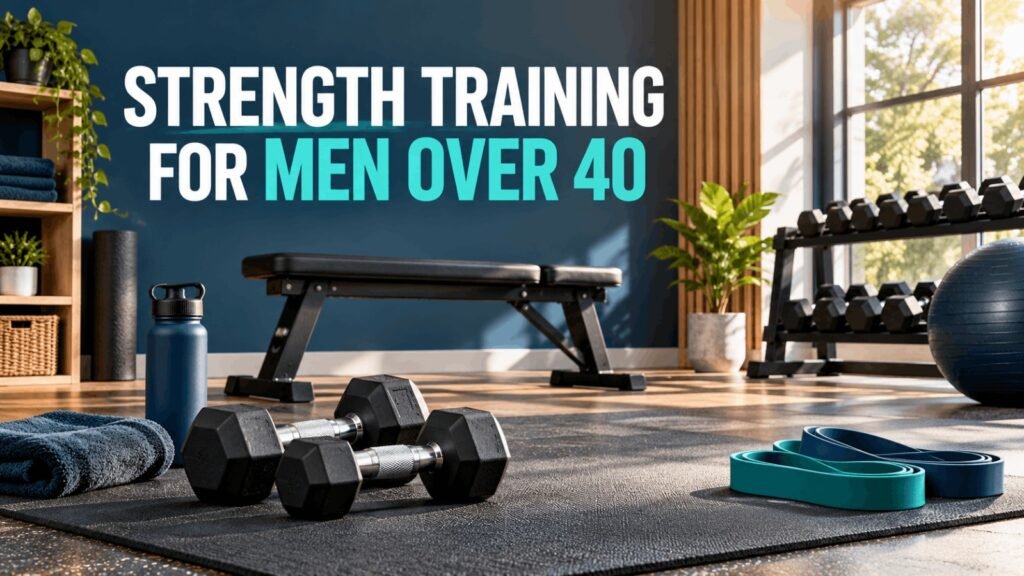
If you are over 40 and want to become stronger, incorporating strength training for men over 40 will help you build muscle. A consistent, manageable approach to strength training for men over 40 can help you practice the movements used in daily life, maintain muscle, and build confidence in your physical ability.
This guide explains how effective strength training for men over 40 allows you to start your journey, choose beginner-friendly exercises, train at home or in a gym, recover between sessions, and recognize when professional medical advice is appropriate. It is designed for generally healthy adults who are new to resistance exercise—not as a diagnosis or personalized treatment plan.
What strength training for men over 40 involves
Strength training, also called resistance training, makes muscles work against resistance. The resistance may come from body weight, a resistance band, dumbbells, machines, or another safe training tool. Examples include a chair squat, wall push-up, band row, and controlled hip hinge.
The aim is to give the body a challenge it can adapt to while keeping the movement controlled. Progress may mean using slightly more resistance, completing an additional repetition, moving through a comfortable range of motion, or performing the same exercise with better control. It is not measured only by the number on a barbell.
A balanced full-body session usually includes movement pattern
s for the legs, hips, back, chest, shoulders, arms, and trunk. Rest matters too: the body needs time between demanding sessions to recover and adapt. If you are building wider habits around exercise, our guide to a sustainable fitness lifestyle provides a broader framework.
Why strength training after 40 is worth doing

Age does not create a sudden cutoff for building strength. Your starting point, previous training, sleep, nutrition, health conditions, and consistency all affect your results. Resistance training is useful because it gives muscles a regular reason to keep working.
It supports everyday capability
Strength is practical. It can help you practice carrying shopping, standing from a chair, climbing stairs, lifting a suitcase, and moving through daily tasks with more control. No exercise can guarantee that you will never be injured, but gradually building capacity can make movement more familiar and manageable.
It can support muscle and body-composition goals
Strength training can help preserve or build muscle while you work toward broader health or body-composition goals. The scale is only one measure of change. Repetitions, resistance, waist measurement, clothing fit, and ease with daily tasks may also provide useful feedback.
Fat loss is influenced by food intake, sleep, activity, medications, and health conditions. Lifting weights alone does not guarantee a smaller waist, so avoid programs that promise instant transformation.
It can complement healthy aging
Regular movement may support general well-being, confidence, and independence. It is not a replacement for mental-health care, medical treatment, or a balanced lifestyle. The most useful program is one you can repeat without making pain or exhaustion your measure of success.
How to start safely
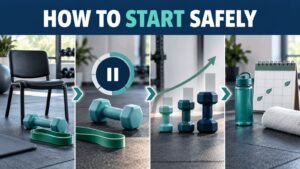
Choose movements you can control
Start with variations that allow smooth movement through a comfortable range. A chair squat is easier to control than a heavy barbell squat; a wall push-up is a reasonable starting point before a floor push-up. If an exercise feels unstable or causes pain, reduce the range, use an easier variation, or stop and ask a qualified professional for help.
Use moderate effort
During your first few weeks, finish a set feeling that you could still perform a few good repetitions. You do not need to test a one-repetition maximum or train to failure to make progress. Light-to-moderate resistance gives you time to learn technique and notice how your body responds.
Progress one variable at a time
When you can complete the planned repetitions with steady form and no concerning symptoms, make one small change. Add one or two repetitions, use a slightly stronger band, or increase the weight modestly. Avoid adding weight, sets, and training days at the same time.
Leave recovery time
Place at least one rest day between challenging full-body sessions while you are learning. Walking and gentle mobility can be used on other days if they suit your health. Severe soreness that disrupts daily movement is a reason to reduce the next session and allow more recovery—not a reason to push harder.
A simple two-day beginner routine
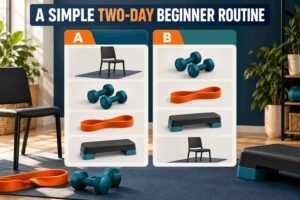
This is a general starting framework, not a personalized exercise prescription. Begin with one set of each movement and a light effort. If you are recovering well after several sessions, build toward two sets. Rest for roughly one to two minutes, or longer if needed to breathe comfortably and maintain form.
| Movement pattern | Beginner exercise | Starting range |
| Squat or sit-to-stand | Chair squat | 8–12 repetitions |
| Push | Wall or elevated push-up | 6–12 repetitions |
| Pull | Resistance-band row | 8–12 repetitions |
| Hip hinge | Unweighted hinge or light dumbbells | 8–12 repetitions |
| Step or single-leg support | Low step-up while holding a rail | 6–10 each side |
| Trunk stability | Bird dog or standing band press | 6–10 each side |
Day A: Chair squat, wall push-up, band row, and bird dog.
Day B: Hip hinge, low step-up, supported row, and standing band press.
For example, train on Monday and Thursday. Substitute a sit-to-stand if step-ups bother your knees. Use a standing trunk exercise if getting onto the floor is uncomfortable. A qualified trainer or physical therapist can help you choose alternatives when technique, pain, balance, or a previous injury is a concern.
Home training or gym training?

Both can work. At home, a stable chair, resistance band, and manageable dumbbells may be enough to begin. Inspect bands for damage and attach them only to stable points designed for the load. Keep the training area clear so you can step safely.
A gym provides machines and adjustable weights. Machines can be useful when you are learning because they guide the path of movement, but seat position and range still need to be adjusted correctly. Ask staff for an equipment demonstration if you are unsure.
In either setting, select a resistance you can control without twisting, rushing, or holding your breath. More equipment does not automatically produce better results; consistent practice and appropriate progression matter more.
How to fit training into a busy schedule
Two sessions of 25–40 minutes may be more realistic than planning five workouts and repeatedly missing them. Choose two fixed days and keep one backup slot. If a full session is impossible, complete a shorter version with three or four movements rather than treating the whole week as lost.
Walking and strength training have different roles. Walking can support aerobic fitness and daily movement; resistance exercise challenges muscles. They can complement each other. If you currently do very little activity, start with short, comfortable sessions and increase gradually. For additional practical scheduling ideas, see our guide to staying active with a busy schedule.
Food, protein, sleep, and recovery
Training is only one part of progress. Regular meals that include protein-containing foods—such as eggs, fish, poultry, beans, lentils, yogurt, or tofu—can support overall nutrition. The appropriate amount varies with body size, diet, kidney health, medications, and activity level.
If you have kidney disease, diabetes, a prescribed diet, or another health condition, ask your clinician or dietitian before significantly changing protein intake or using supplements. You do not need a special powder to begin. Be cautious with products promising rapid muscle gain, fat loss, or hormone changes.
Sleep supports recovery, mood, appetite regulation, and the ability to train consistently. If a late workout would significantly reduce your sleep, a shorter session may be the better choice. Soreness is not proof that a workout was effective; steady progress with controlled form is a more useful target.
How to measure progress
Keep a simple log of the exercise, resistance, repetitions, and how the session felt. Also note practical changes: carrying groceries feels easier, you need less support to stand, or you recover more comfortably after a walk.
If fat loss is a goal, use longer-term trends rather than judging progress by daily body weight. Waist measurement, clothing fit, and strength changes can add context. Avoid frequent tracking if it increases anxiety or leads to unhealthy food or exercise behaviors.
Common mistakes to avoid
Doing too much too soon
A hard first week can cause excessive soreness and make the next session less likely. Start below your maximum and add work gradually.
Chasing heavy weights before learning technique
Use a load that allows controlled repetitions. Stop the set when you can no longer maintain good form. A qualified trainer can review unfamiliar exercises.
Training through sharp pain
Muscular effort and mild delayed soreness are different from sudden or sharp pain. Stop the movement that causes sharp pain. Persistent or worsening pain deserves medical or physiotherapy advice.
Copying an advanced social-media routine
Another person’s program may not match your equipment, training history, mobility, or health. Progress from your baseline rather than comparing weights.
Treating supplements as a shortcut
Supplements cannot replace regular training, adequate food, sleep, and appropriate medical care. Ask a pharmacist or doctor about possible interactions if you take medication.
When to speak with a doctor
Ask a qualified doctor before starting or substantially changing a routine if you have heart disease, diabetes, uncontrolled blood pressure, kidney disease, a recent operation, significant joint or back problems, a condition affecting balance, or uncertainty about safe exercise intensity. The same applies if medication may affect blood sugar, heart rate, blood pressure, or balance.
Stop exercising and seek urgent medical help for chest pressure or pain, fainting, severe or unusual shortness of breath, or symptoms that feel alarming. For nonurgent but persistent pain, dizziness, unusual fatigue, or a marked drop in exercise tolerance, arrange a medical assessment before progressing.
This article is general education. It does not diagnose, treat, or replace advice from your healthcare team. A qualified trainer or physical therapist can help adapt movements when pain, mobility limitations, or previous injuries are involved.
A four-week starting plan
Week 1: Establish a baseline
- Choose two nonconsecutive training days.
- Perform one light set of five or six movements.
- Stop while your form is still controlled.
- Record any movement that causes pain or instability.
Weeks 2–3: Repeat before changing
- Keep the same basic exercises so technique can improve.
- Add a second set only if recovery is going well.
- Add easy walking on other days if appropriate for your health.
- Keep sleep and meal habits as consistent as possible.
Week 4 and beyond: Progress slowly
- Add a few repetitions or a small amount of resistance to selected exercises.
- Change only one or two parts of the routine at a time.
- Review your log for improvements in control, strength, and daily tasks.
- Pause progression and seek professional advice if concerning symptoms appear.
Frequently asked questions
How many days a week should men over 40 strength train?
Two nonconsecutive full-body sessions are a practical starting point for many healthy adults. Some people later choose three sessions, but more is not required to begin. Adjust for recovery, schedule, health, and professional advice.
Can men build muscle after 40?
Yes. Men can build strength and muscle beyond 40. Results depend on appropriate resistance, consistency, nutrition, rest, and individual health. Expect gradual change rather than an instant transformation.
Is weight training safe at 45 or 50?
Age alone is not a reason to avoid resistance exercise. Start with manageable movements and light resistance. If you have chronic conditions, significant pain, recent surgery, or concerning symptoms, speak with a doctor first.
Do I need a gym?
No. Body-weight exercises, bands, and dumbbells can provide useful resistance at home. A gym offers more equipment, but safe setup, controllable resistance, and consistency matter more than location.
Should I lift very heavy to increase testosterone?
No. You do not need very heavy weights for general strength. Resistance exercise supports fitness, but it should not be presented as a guaranteed treatment for low testosterone or a hormone disorder. Discuss persistent symptoms with a qualified doctor instead of self-diagnosing.
How long should a beginner workout last?
A beginner session can take about 20–40 minutes, including a brief warm-up, several movements, and rest. Shorter sessions can still help establish the habit. Duration should match your starting level and recovery.
What should I eat after training?
A regular balanced meal containing a protein source and other nourishing foods is enough for many people. A special post-workout product is not essential. Ask your care team before changing food or supplements if you have kidney disease, diabetes, or a prescribed diet.
Final takeaway
Adopting a consistent strength training for men over 40 plan will help you achieve your fitness goals effortlessly. The best strength training for men over 40 is not the most complicated program. It is a manageable routine that you can repeat, progress gradually, and adapt to your health and schedule. Start with two light full-body sessions, practice smooth movement, and give recovery the same importance as effort.

Pingback: How to Stay Strong and Active After 40 - OptiFit Living – Smart Health & Fitness for Men Over 40