You do not need a gym to get stronger after 40. A chair, a wall, a staircase and the floor are enough to start. This guide gives you a home workout without equipment for beginners: eight simple moves, a warm-up, a four-week plan and clear rules for staying safe. Nothing here needs special gear, and every move has an easier version if your first try feels too hard.
A short note on where this comes from. It is based on public health guidelines from the CDC and the National Institute on Aging, not on personal training claims. It is general information, not medical advice. If you have a heart condition, chest pain, joint problems or you have not exercised in years, talk to your doctor before you begin.
How much exercise do you actually need?
The CDC says adults need 150 minutes of moderate activity each week, or 75 minutes of vigorous activity, or a mix of the two. Adults also need muscle-strengthening work on at least 2 days a week, and that work should use all the big muscle groups: legs, hips, back, belly, chest, shoulders and arms.
That sounds like a lot, but it breaks down well. Thirty minutes a day for five days makes 150 minutes. Two of those days can be the strength workout in this article. The other days can be a brisk walk.
You can also split the time. Three short walks of ten minutes count the same as one walk of thirty. For a beginner, that makes it easier to stay consistent, which matters more than how hard you push. A workout without equipment can meet the strength part of these guidelines.
Before you start: warm up for five minutes
A warm-up raises your heart rate slowly and loosens your joints. The NIA’s home routine begins with a warm-up and ends with stretching, and the same pattern works here. Spend about five minutes on this.
- March in place for one minute, lifting your knees to a comfortable height.
- Roll your shoulders backward ten times.
- Do ten gentle arm circles in each direction.
- Do ten slow hip circles, hands on your hips.
- Do ten shallow squats to a chair, using only half the range of motion.
You should feel a little warmer, not tired. If a joint hurts, skip that move and tell your doctor if the pain keeps coming back. Even a short workout without equipment should start with this warm-up.
Eight no-equipment moves for beginners
Each move below has a standard version and an easier one. Start with the easier version if you are unsure. Move slowly, breathe out on the hard part, and keep your joints slightly bent rather than locked straight.
1. Chair squat
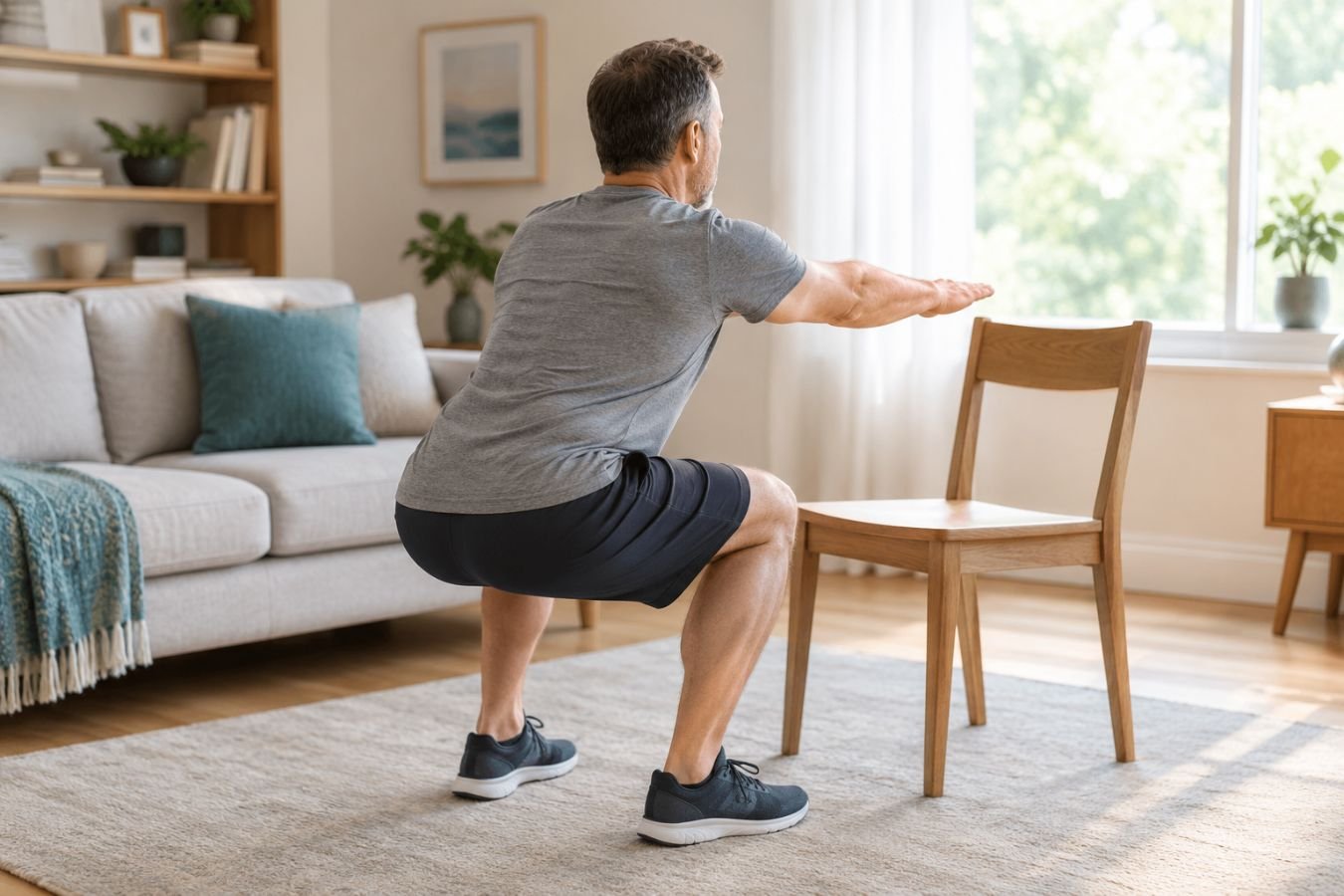
Stand in front of a sturdy chair with your feet shoulder-width apart. Push your hips back, lower yourself until you lightly touch the seat, then stand up. This trains your thighs and hips, which you use every time you climb stairs or get out of a car. If it feels hard, put a cushion on the chair to make the seat higher. Try 8 to 10 repeats.
2. Wall push-up
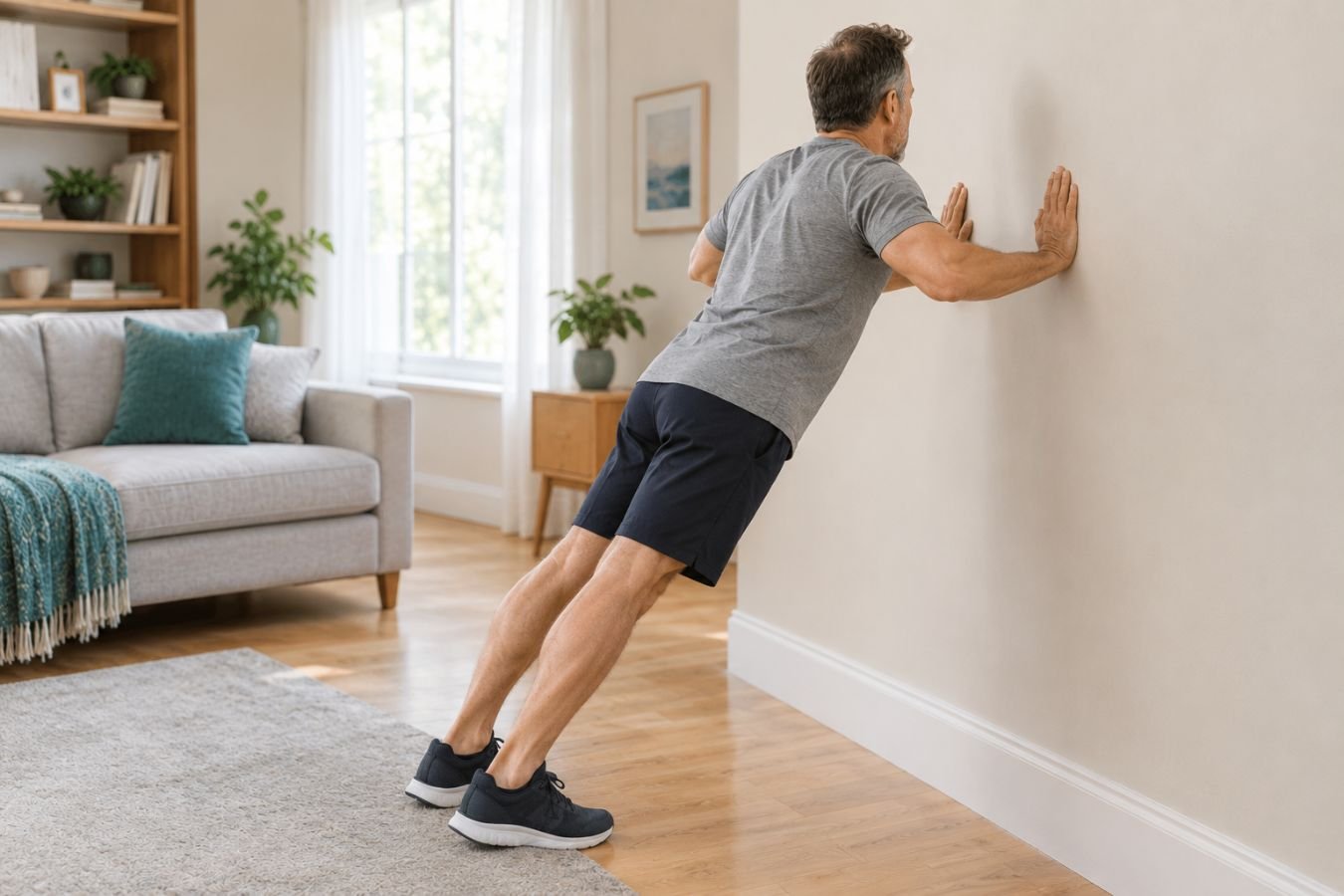
Stand an arm’s length from a wall. Place your hands on the wall at chest height, bend your elbows to bring your chest toward the wall, then push back. This works your chest, shoulders and arms. When it gets easy, move to a kitchen counter, then a sturdy table, then the floor. Try 8 to 10 repeats.
3. Glute bridge
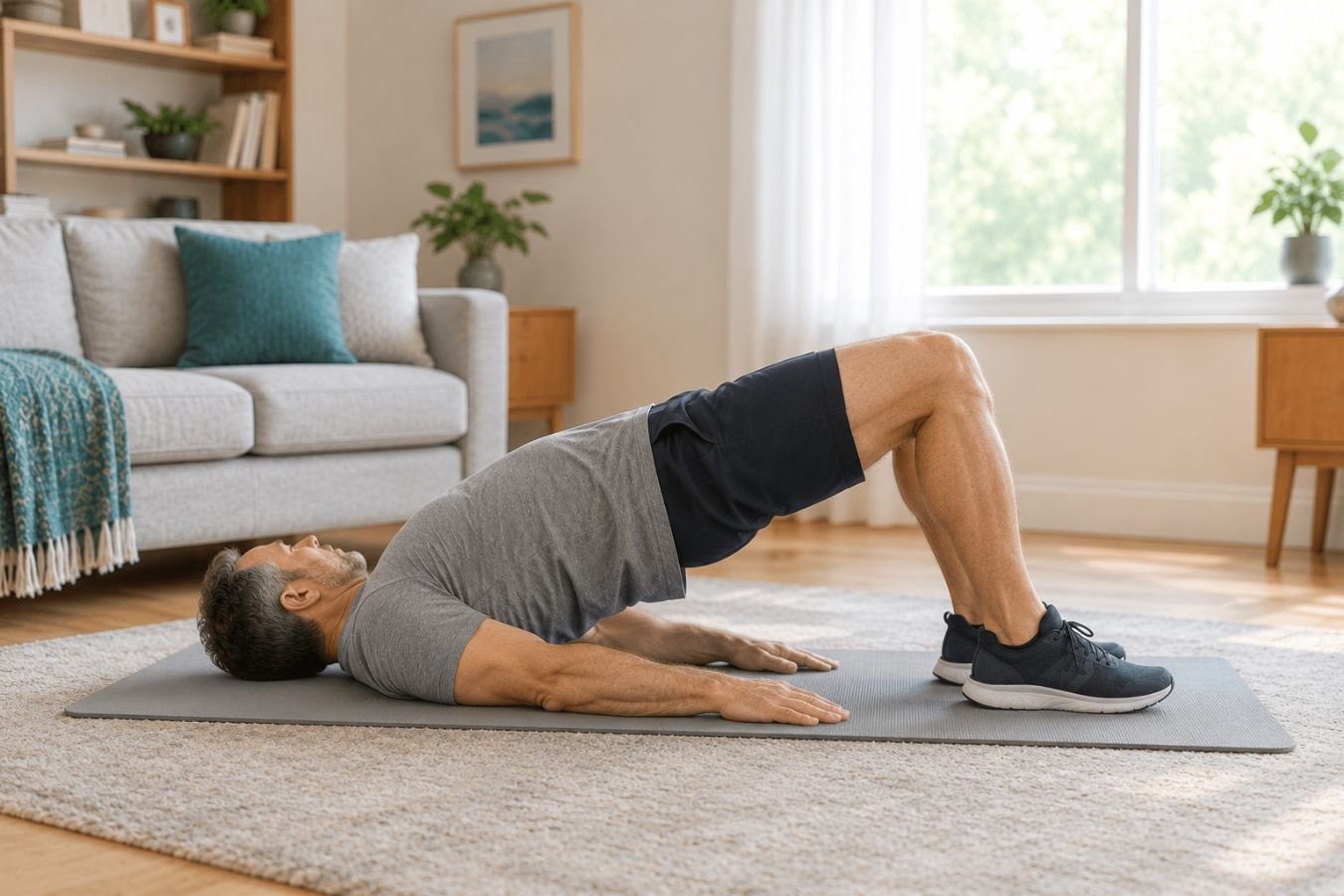
Lie on your back with your knees bent and feet flat. Press through your heels and lift your hips until your body makes a straight line from shoulders to knees. Hold for one second and lower. This strengthens your buttocks and lower back, and it is easy on the knees. Try 10 to 12 repeats.
4. Bird dog
Start on your hands and knees. Reach one arm forward and the opposite leg back at the same time, keep your hips level, then return. This trains your core and balance without putting weight on your spine. Switch sides each time. Try 6 to 8 on each side.
5. Reverse lunge
Hold the back of a chair for balance. Step one foot back, lower your back knee toward the floor, then push through the front foot to stand. Stepping backward is easier on most people’s knees than stepping forward. Try 6 to 8 on each leg.
6. Step-up
Use the bottom stair or a low, solid step. Place one foot on it, press through that foot to stand up tall, then lower back down slowly. Hold a railing if you need to. This is a good test of real-life leg strength. Try 6 to 8 on each leg.
7. Incline plank
Place your hands on a counter or sturdy table and walk your feet back until your body forms a straight line. Hold, breathing normally, for 15 to 20 seconds. Lower the surface to the floor later as you get stronger. This builds the muscles around your middle.
8. Calf raise
Stand behind a chair and hold it lightly. Rise onto your toes, pause, and lower slowly. Strong calves help with walking and balance. Try 12 to 15 repeats. Together, these eight moves make a complete workout without equipment.
Easier and harder versions at a glance
Use this table to move up only when the current version feels comfortable for two sessions in a row.
| Move | Easier | Standard | Harder |
|---|---|---|---|
| Squat | Chair with cushion | Chair squat | Slow squat, pause at the bottom |
| Push-up | Wall | Kitchen counter | Knees or full floor push-up |
| Bridge | Both feet, short hold | Both feet, hold 2 seconds | One leg at a time |
| Lunge | Shallow, holding a chair | Reverse lunge | Slow reverse lunge, no support |
| Plank | Wall | Counter, 20 seconds | Floor, on knees |
A simple four-week plan
Do the strength workout twice a week on non-consecutive days, and walk on other days. Rest is when your muscles actually get stronger, so do not skip it.
| Week | Strength days | What to do | Walking |
|---|---|---|---|
| 1 | 2 | Pick 5 moves, 1 set of 8 each | 3 walks of 15 minutes |
| 2 | 2 | All 8 moves, 1 set of 8 each | 3 walks of 20 minutes |
| 3 | 2 | All 8 moves, 2 sets of 8 each | 4 walks of 20 minutes |
| 4 | 2 | All 8 moves, 2 sets of 10 each | 4 walks of 25 minutes |
Rest for about a minute between sets. If you feel very sore or worn out, repeat the previous week instead of moving on. Nobody gives out prizes for rushing. This plan turns the moves into a workout without equipment that builds week by week.
What your first session looks like
It helps to know what a real session feels like, so here is a simple walk-through of week one. It takes about 25 minutes.
- Warm up for five minutes with the moves above.
- Do one set of 8 chair squats. Rest for a minute.
- Do one set of 8 wall push-ups. Rest for a minute.
- Do one set of 10 glute bridges. Rest for a minute.
- Do 6 bird dogs on each side. Rest for a minute.
- Do 12 calf raises while holding a chair.
- Cool down and stretch for five minutes.
That is five moves, one set each. You should finish feeling like you did something, but able to keep talking and walk to the kitchen without a problem. If you could do twice as many repeats, add a few next time. If you were shaking by the end, do fewer. Your first workout without equipment should feel easy enough to repeat.
If something hurts: simple swaps
Small aches are common when you start. Here are some easy changes that keep you moving without making the problem worse.
- Sore knees: use a higher chair seat for squats, skip lunges for now and choose glute bridges and calf raises instead.
- Sore shoulders: keep your hands lower on the wall push-up, or do the bridge and bird dog first.
- Tight lower back: choose bridges and bird dogs, and avoid deep forward bending. Keep your belly gently tight on every move.
- Sore wrists: make a loose fist on the counter, or do wall push-ups with your fingers pointing slightly outward.
These are common-sense options, not a diagnosis. If pain lasts more than a few days, or it wakes you at night, see a doctor or a physical therapist. You can adjust any workout without equipment to protect a sore joint.
What to do when you miss a workout
Everyone misses sessions. A busy week, a cold or a trip can all break the plan. Do not try to make up for it by doing two workouts in one day. Just do the next planned session. If you missed more than a week, repeat the last week you finished before you move up. Starting again is not failure. It is part of the process, and the plan is built to let you restart at any time.
Cool down and stretch
End each session with five minutes of easy movement. Walk slowly in place for a minute, then hold each stretch for about 20 to 30 seconds without bouncing. Good choices are a calf stretch against a wall, a seated hamstring stretch, a chest stretch in a doorway and a gentle neck tilt. Stretching should feel like a pull, never a sharp pain.
Safety rules that matter
Most beginners get hurt by doing too much too soon, not by doing too little. These rules lower that risk. Safety rules matter just as much in a workout without equipment as in a gym.
- Clear rugs, cords and clutter from the area where you exercise.
- Wear shoes with a firm sole and clothes that let you move freely.
- Drink water before and after, even if you do not feel thirsty.
- Breathe steadily. Breathe out on the effort, and do not hold your breath.
- Stop right away if you have chest pain, trouble breathing or dizziness, and call a doctor.
- Expect mild muscle soreness for a day or two. Sharp or joint pain is different, and it is a reason to stop that move.
Eat and sleep to support your workouts
Exercise breaks down muscle a little, and food and sleep repair it. Aim to include some protein at each meal, such as eggs, fish, beans, yogurt or chicken. Eat vegetables and whole grains for energy, and drink enough water. Most adults do best with seven or more hours of sleep. If you are very short on sleep, your plan may feel harder than it should, so be patient with yourself. Our guide on how sleep affects testosterone levels explains why rest matters so much for men over 40. Food and sleep decide how well a workout without equipment pays off.
Common mistakes to avoid
Doing too much in week one is the biggest one. Another is skipping the warm-up because you feel short on time. A third is comparing yourself with younger people who have trained for years. Your only goal is to be a little stronger next month than you are today. A fourth mistake is training the same muscles every day. Give each muscle group at least a day to recover, which is why the plan uses two strength days a week.
How to track your progress
Pick two or three simple tests and write the result down once every two weeks. For example, count how many chair squats you can do in 30 seconds, how long you can hold an incline plank, and how many minutes you can walk before you feel winded. Write the date and number in a notebook. Small gains add up, and seeing them helps you keep going on days when you do not feel like moving. Tracking your workout without equipment shows progress that the mirror misses.
Questions people ask
Can I build muscle with a home workout without equipment for beginners?
Yes. For someone new to exercise, bodyweight moves are enough to build strength. As you get stronger, you can slow the movement down, add repeats or use harder versions to keep making progress.
How often should I work out at home?
The CDC asks for at least two days of muscle-strengthening work each week. Add walking or other cardio on other days to reach 150 minutes of moderate activity.
Is it too late to start at 40 or 50?
No. The CDC guidelines apply to all adults, and a gradual start with the easier moves is a safe way in. Get your doctor’s advice first if you have a health condition.
How long should each workout take?
The routine in this article takes about 25 to 30 minutes, including the warm-up and the cool-down.
Main reference for this guide: CDC adult physical activity guidelines.