

For most men, steady changes to food and activity start to show on a cholesterol test within about 4 to 12 weeks, with more change over 3 to 6 months. A statin works faster: LDL begins to fall within days, and the effect builds over the first weeks. No version of this works in a few days.
This article is general education, not medical advice. Targets depend on your age, risk factors, and history, so the right timeline for you is a question for your doctor.
The timeline at a glance
The table below is the short version of the whole article. The numbers are typical ranges from the sources above. They describe what is common, not what will happen for you.
| What changed | When it may show on a test |
|---|---|
| Food and activity, steady changes | About 4 to 12 weeks, often noticeable at 6 to 8 weeks, with more over 3 to 6 months |
| Starting or changing a statin | LDL begins to fall within weeks; first retest at 4 to 12 weeks, per the 2018 AHA/ACC guideline |
| First retest after a statin is started or changed | 4 to 12 weeks, per the 2018 AHA/ACC guideline |
| Checks after that | Every 3 to 12 months, as needed |
| Weight loss of 5 to 10 percent of body weight | Measurable change over a few months, as the weight comes off |
| Quitting smoking | HDL, the “good” cholesterol, can start to improve within weeks |

Why cholesterol moves slowly
Cholesterol is mostly set by the liver, not by yesterday’s lunch. The liver makes cholesterol every day and clears LDL through receptors on its cells. Food, activity, weight, and medication change that balance gradually: less saturated fat means the liver clears LDL better, soluble fiber pulls cholesterol out through digestion, and a statin blocks one step the liver uses to make cholesterol. None of that resets overnight.
That is also why a single test can mislead. Cholesterol varies a little from day to day, so doctors retest after a real interval, usually 4 to 12 weeks after a change.
Your starting point matters too. A man with an LDL of 130 mg/dL who cuts saturated fat and walks daily may reach his goal in a few months. A man with an LDL of 190 mg/dL and a family history of early heart disease may need medication as well.
How long does it take with diet alone?
With food changes alone, expect the first meaningful shift at about 6 to 8 weeks, and a clearer picture at 3 months. The American Heart Association notes that replacing saturated fat with unsaturated fat, adding soluble fiber, exercising, and losing modest weight typically lower LDL by around 5 to 15 percent combined. That is enough for a man near a threshold with low overall risk, and not enough on its own for a man far above it.
Saturated fat is the biggest food lever on LDL. The American Heart Association advises keeping it under about 6 percent of daily calories, about 13 grams on a 2,000 calorie day. The main sources are fatty meat, butter, cheese, cream, and processed meats. Swapping those for olive oil, nuts, fish, and beans does more in six weeks than any single “superfood” does in six months.
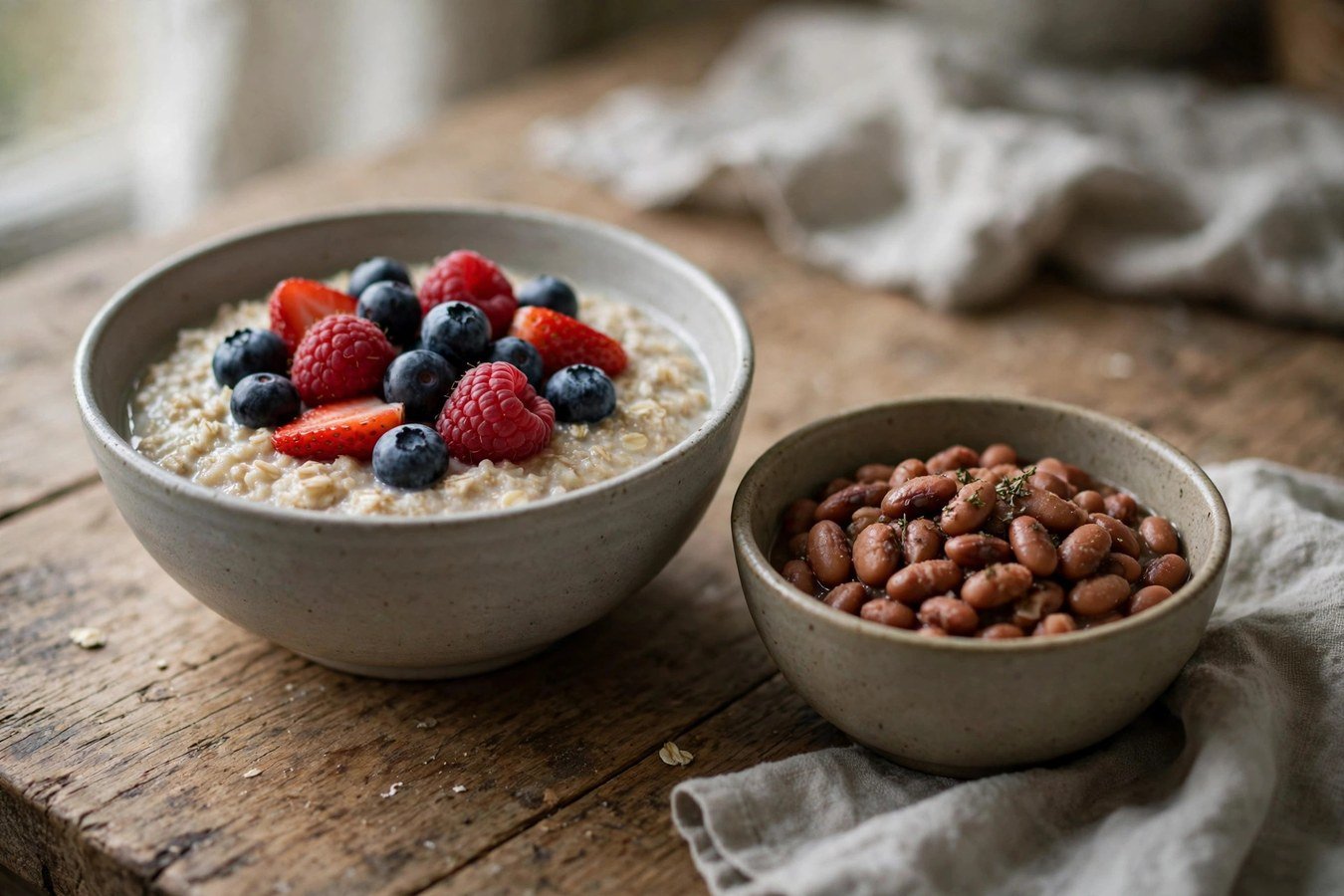
Soluble fiber is the second lever. The National Heart, Lung, and Blood Institute notes that 5 to 10 grams a day can lower LDL by about 5 percent. Oats, beans, lentils, and barley are the practical sources, and a bowl of oatmeal plus a serving of beans gets most men there without a supplement. Plant sterols add a little more: about 2 grams a day can lower LDL by around 5 to 15 percent.
The pattern matters more than any one food. A Mediterranean or DASH style pattern, rich in vegetables, whole grains, fish, olive oil, and nuts, and low in saturated fat and sodium, is the pattern the AHA and NHLBI point to. One good week does not move the number. Twelve steady weeks do.
How long does it take with exercise alone?
Exercise alone moves cholesterol more slowly than food does, and its clearest effect is on triglycerides and HDL rather than LDL. The American Heart Association recommends at least 150 minutes of moderate aerobic activity a week, plus strength work on two days. Improvements can show within about 6 to 8 weeks, with more over 3 to 6 months.
Exercise also makes the food changes work better: a man who walks briskly most days and cuts saturated fat will usually see a bigger drop at 12 weeks than a man who does only one of those things. Do not judge it at two weeks. Give it the same 4 to 12 week window.

How long does it take with weight loss?
Weight loss moves cholesterol over months, not weeks. A gradual loss of 1 to 2 pounds a week is the pace the CDC describes as sustainable. Losing 5 to 10 percent of body weight, about 10 to 20 pounds for a 200 pound man, is the range where cholesterol, blood pressure, and blood sugar usually improve together.
The first pounds often bring the biggest early change in triglycerides, while LDL follows more slowly. Crash diets break this pattern: a very low calorie diet can drop the number fast on paper and rebound when normal eating returns. The timeline that counts is the one you can still be following in six months.
How long does it take with a statin?
Statins are the fastest reliable route. Most begin lowering LDL within days, and the effect builds over the first weeks of treatment. How much LDL falls depends on the drug, the dose, and your starting number.
The 2018 AHA/ACC guideline recommends repeating the lipid test 4 to 12 weeks after a statin is started or its dose is changed, then every 3 to 12 months as needed. That retest confirms the drug is working, and it is where the dose is adjusted if the drop is smaller than planned.
Two warnings. First, the benefit depends on keeping LDL low over years, and levels return toward where they were within weeks of stopping, so a statin is generally long term. Do not stop one because a single test looks good. Second, never start, stop, or change the dose of a cholesterol drug on the basis of an article. That decision belongs to the prescriber.
How long to fast to lower cholesterol?
Fasting follows the same timeline as other food changes: weeks to months, not days. Intermittent fasting can lower LDL when it leads to eating less overall and losing weight, and the first measurable change usually shows at about 6 to 12 weeks. Fasting by itself, without a change in what you eat when you do eat, does not reliably lower cholesterol.
There is no good evidence that fasting lowers cholesterol faster than an ordinary heart healthy pattern with the same calories. The benefit in studies mostly comes through weight loss and better food choices during eating windows, not through the fast itself.
Fasting is not safe for everyone. Men with diabetes, low blood pressure, a history of eating disorders, or medicines that must be taken with food should talk to a doctor before trying it.
What speeds up or slows down your timeline
The same plan can take six weeks for one man and six months for another. The usual reasons are below.
Starting LDL. The higher the starting number, the longer the road, and the more likely medication is part of the plan. A small gap closes with food alone. A large gap usually does not.
How consistent the changes are. Cholesterol responds to the average week, not the best day. Five steady days still move the number, just more slowly than seven.
Genetics. Familial hypercholesterolemia, where the liver clears LDL poorly from birth, makes diet alone slow and often insufficient. If your LDL is very high, or close relatives had heart disease young, tell your doctor.
Smoking and alcohol. Smoking lowers HDL, and quitting can improve it within weeks. Heavy drinking raises triglycerides. Cutting back helps the whole panel.
Sleep and stress. Short sleep and chronic stress do not directly set LDL, but they make every other change harder.
Medicines and other conditions. An underactive thyroid, some medicines, and kidney or liver conditions can raise cholesterol. If your numbers do not move after three steady months, ask your doctor to check for these.
A 4-week starter plan
A way to start, not a prescription, built to be in full swing by the first retest window.
Week 1: Measure and swap. Get a baseline lipid panel if you do not have a recent one. Write down everything you eat for three days and circle the saturated fat: butter, cheese, fatty meat, processed meat, cream. Swap one of them a day for olive oil, beans, fish, or nuts. Walk 30 minutes on five days.
Week 2: Add fiber and a pattern. Add oats at breakfast and beans or lentils at one meal a day. Keep walking, and add two short strength sessions, even 20 minutes at home.
Week 3: Check the drink and smoke levers. Cut sugary drinks and keep alcohol small or none on most days. If you smoke, set a quit date and ask your doctor about support. Sleep 7 to 8 hours where you can.
Week 4: Lock the routine. By now the swaps should feel ordinary. Weigh yourself once, note the trend, and book the retest for 4 to 12 weeks after you started, not next week.

What to check, and when
A single number is a snapshot. Before you start, get a full lipid panel, with total cholesterol, LDL, HDL, and triglycerides, plus blood pressure and weight. That is the baseline everything is measured against.
Retest 4 to 12 weeks after a change, whether the change is food, activity, or a new statin. Testing earlier usually measures noise. After that, check every 3 to 12 months, more often while a dose is being adjusted, less often once the number is stable.
If the number does not move after 3 steady months, talk to your doctor before changing anything yourself. Keep your results in one place with the date. A row of numbers over a year tells you far more than any one test.
Common mistakes
Testing too soon. A test at two weeks measures a body still adjusting. Wait for the 4 to 12 week window.
Stopping a statin when the number drops. The drop is the drug working. Stopping brings the number back within weeks. Only your prescriber changes the plan.
Chasing one food. Oatmeal helps, and so do nuts, fish, and beans. No single food carries the result.
Treating a crash diet as a timeline. Fast drops that cannot be kept are not a shorter timeline. They are a detour that ends where it started.
Ignoring triglycerides and HDL. LDL is the headline number, but high triglycerides and low HDL add risk of their own. The same food and activity changes help all three.
Comparing your timeline to someone else’s. Age, starting LDL, genetics, and medicines make every timeline personal. Your retest is the only comparison that matters.
When to see a doctor first
See your doctor before starting a cholesterol plan if you have heart disease, diabetes, or high blood pressure; have had a heart attack or stroke; a close relative had heart disease before 60; your LDL is above 190 mg/dL; or you take medicines that affect cholesterol. See a doctor promptly if a statin brings severe muscle pain, dark urine, or yellowing of the skin, and seek urgent care for chest pain, breathlessness, or sudden weakness.
Your doctor knows your history, medicines, and risk, and can set a target and a retest date that fit you.
Questions people ask
How long does it take to lower cholesterol with diet alone?
Usually 4 to 12 weeks for the first measurable change, with more over 3 to 6 months. The 2018 AHA/ACC guideline uses the same 4 to 12 week window for the first retest.
Do statins work faster than diet?
Yes. A statin usually begins to lower LDL within days, and the effect builds over the first weeks. Diet and exercise alone usually take 6 to 8 weeks to show clearly, and 3 to 6 months for the fuller effect.
Can I lower my cholesterol in two weeks?
Not meaningfully. The liver adjusts over weeks, not days, and a test at two weeks mostly measures normal variation. Judge the plan on the 4 to 12 week retest.
How often should I retest my cholesterol?
4 to 12 weeks after starting or changing a statin or a serious lifestyle change, then every 3 to 12 months once things are stable. Your doctor may test more often while a dose is being adjusted.
Does fasting lower cholesterol faster?
No. Fasting helps when it leads to eating less overall and losing weight, and then it follows the same 6 to 12 week timeline as other diet changes. Talk to a doctor first if you have diabetes, take medicine with food, or have a history of eating disorders.
What if my numbers have not moved after three months?
First check the routine honestly: was the food pattern steady most days, or only on good weeks? If it was steady, see your doctor. A flat result after three steady months is information, not failure.
Built from the 2018 AHA/ACC cholesterol guideline, the American Heart Association, the National Heart, Lung, and Blood Institute, and the CDC. Where sources give a range, this guide shows the range. We did not test these methods or run trials for this guide. Last checked: 20 November 2026.