
The power of discipline over motivation is simple to state. Motivation is a feeling, and feelings change by the day. Discipline is a set of rules and routines that get you moving even when the feeling is gone.
This guide explains why motivation is a weak plan, what research says about building habits, and how to use if-then plans and a 30-day schedule to make exercise, sleep and food choices automatic. It also shows when “just be more disciplined” is the wrong advice.

Why motivation is a weak plan
Motivation rises after a good night’s sleep, a strong week at work or a fresh goal on January 1. It drops when you are tired, stressed or bored. If your routine depends on feeling like it, your routine will follow your mood.
Think about the days you skip a workout. It is rarely because you decided exercise no longer matters. It is because on that day the feeling was missing, and nothing else was in place to carry you.
Discipline fills that gap. It does not wait for the feeling. It relies on decisions made earlier, when you were calm, so you do not have to make them again when you are not.
Motivation vs discipline at a glance
| Motivation | Discipline | |
|---|---|---|
| What it is | A feeling or drive | A routine and a set of rules |
| Reliability | Changes with mood and energy | Holds on good and bad days |
| Works best for | Starting something new | Keeping it going for months |
| Fails when | You are tired, busy or stressed | The plan is too big or vague |
| How to use it | Use it to start, then build a system | Make it small, specific and scheduled |
The point is not that motivation is bad. Use it to begin. Just do not rely on it to continue.
What discipline actually means
Many people think discipline means gritting your teeth and forcing yourself. That picture is often wrong. The most consistent people usually rely less on willpower, not more. They shape their day so the right action is the easy one.
You may have heard that willpower is like a fuel tank that runs dry. This idea, called ego depletion, was popular for years. But a 2016 preregistered replication across 23 labs, with 2,141 participants, found an effect close to zero (d = 0.04). The result is still debated, and the original researchers criticised the study’s task choice.
The sensible takeaway is modest. Do not build your plan on the belief that willpower is a limited tank. Build it on routines, cues and a plan that does not demand heroics.
What research says about forming habits
A study from University College London tracked 96 people for 84 days as they tried to adopt a daily health behaviour. On average, it took 66 days for the behaviour to reach its peak level of automaticity. The range was wide, from 18 days to an estimated 254 days, and the longest figure is an extrapolation because the study stopped at 84 days. You can read the summary on the UCL news page.
Three points stand out.
- The popular “21 days” figure does not come from this research.
- Missing a single day did not significantly slow habit formation.
- People who were very inconsistent did not form the habit.
Even at 84 days, about half the participants had not reached the level researchers would call a habit. So if you are two months in and it still takes effort, that is normal.

Use if-then plans
An if-then plan, also called an implementation intention, links a specific situation to a specific action. The format is “If X happens, then I will do Y.” It removes the decision at the moment you are least likely to make a good one.
A 2006 meta-analysis by Gollwitzer and Sheeran pooled 94 tests and found a medium-to-large effect on goal attainment (d = 0.65). A much larger later synthesis of 642 tests found smaller effects, around d = 0.36 overall and about 0.27 for behavior change. So if-then plans help, but expect a modest boost, not a miracle.
Here are examples you can copy.
- If it is 6:30 a.m. on a weekday, then I put on my shoes and walk for 20 minutes.
- If I finish dinner, then I take a 10 minute walk before I sit down.
- If I feel like skipping the gym, then I do just the first set.
- If I get into bed, then my phone goes on the charger across the room.
The more specific the time and place, the better the plan works.
Make the right action easy
Discipline gets easier when the environment helps. Small changes add up.
- Lay out your gear the night before. Shoes by the door, gym bag packed.
- Shrink the starting point. Plan for 5 minutes, not an hour. Starting is the hard part, and you can always do more.
- Remove friction from bad choices. Keep junk food out of the house, or at least out of sight.
- Put it in the calendar. A workout with a time slot beats one with good intentions.
- Do not miss twice. One skipped day is fine. Use it as a rule that you get back on track the very next day.
The last point matches the research. A single missed day did not derail habit formation, but long stretches of inconsistency did.
Build a minimum version of every habit
A minimum version is the smallest action that still counts. It is your fallback for bad days, and it keeps the habit alive when your energy is low. Decide it in advance so you are not negotiating with yourself in the moment.
- Exercise: 10 minutes of walking or one set of each strength move.
- Food: one protein-rich meal and one serving of vegetables, even if the rest of the day is messy.
- Sleep: lights out at your set time and the phone on the charger, even if you cannot fall asleep right away.
- Stress: five slow breaths before you start work.
The aim is to keep showing up. A small action on a hard day builds the identity of someone who does the thing, and that is what carries you through the weeks when motivation never returns.
Discipline with food
Food choices are where willpower plans fail most often, because the decision comes up several times a day. The fix is to decide less, not try harder.
- Plan two or three default breakfasts and lunches you can repeat.
- Shop from a list, and avoid shopping when you are hungry.
- Keep ready-to-eat protein and fruit where you can see them.
- Serve food on a plate instead of eating from the packet.
- Pick a simple rule, such as “no snacking after dinner on weekdays,” and stick to it.
Rules like these remove the daily debate. Over time, the default choice becomes the easy one.
A 30 day discipline plan
Do not try to change everything at once. Build one routine, then add the next.
| Week | Rule | Example |
|---|---|---|
| 1 | One tiny daily habit | Walk 10 minutes after breakfast |
| 2 | Add a fixed time | Same time every day, written in the calendar |
| 3 | Add strength work | Two 20 minute sessions, same days each week |
| 4 | Add a bad-day rule | If I feel low, I do the 5 minute version |
The bad-day rule matters most. It keeps the chain going when motivation is low, which is exactly what discipline is for.
Discipline for men over 40
After 40, recovery slows and time gets tighter, so routines matter more. The CDC adult guidelines call for about 150 minutes of moderate activity a week and muscle strengthening on at least 2 days. That is a schedule problem, not a motivation problem.
Turn it into a calendar. Five 30 minute walks fill the 150 minutes. Two strength sessions on fixed days cover the rest. If the plan lives in your calendar, you are only deciding once.
For ideas on what to do in those sessions, see our guides on strength training for men over 40 and how much exercise per week after 40.
When discipline is not the problem
Sometimes the issue is not a lack of discipline. If you cannot follow even a tiny plan, look for a deeper cause.
- Poor sleep. Tiredness makes everything harder. See our guide to sleep and mental health.
- Low mood or burnout. Constant exhaustion, hopelessness or loss of interest need a doctor, not more willpower.
- A plan that is too big. If you keep failing, shrink the plan.
- Pain or injury. Get it checked before pushing on.
Struggling does not mean you are lazy. It may mean the plan, or your health, needs attention.
How to restart after a break
Everyone falls off the routine at some point, through illness, travel or a busy stretch at work. The danger is not the break. It is the story you tell yourself afterward, such as “I have ruined it, so why bother.”
- Drop the guilt. A break is information, not a verdict.
- Restart small. Go back to the minimum version for a week, not the peak you were at before.
- Re-book the calendar. Put the next three sessions in with exact days and times.
- Tell someone. A friend or partner who asks how it went adds a gentle push.
- Build back slowly. Add time or weight only once the small version feels easy.
The research on habits supports this approach. One missed day barely mattered, while long gaps made habits hard to form. So the goal is to shorten the gaps.
Track it simply
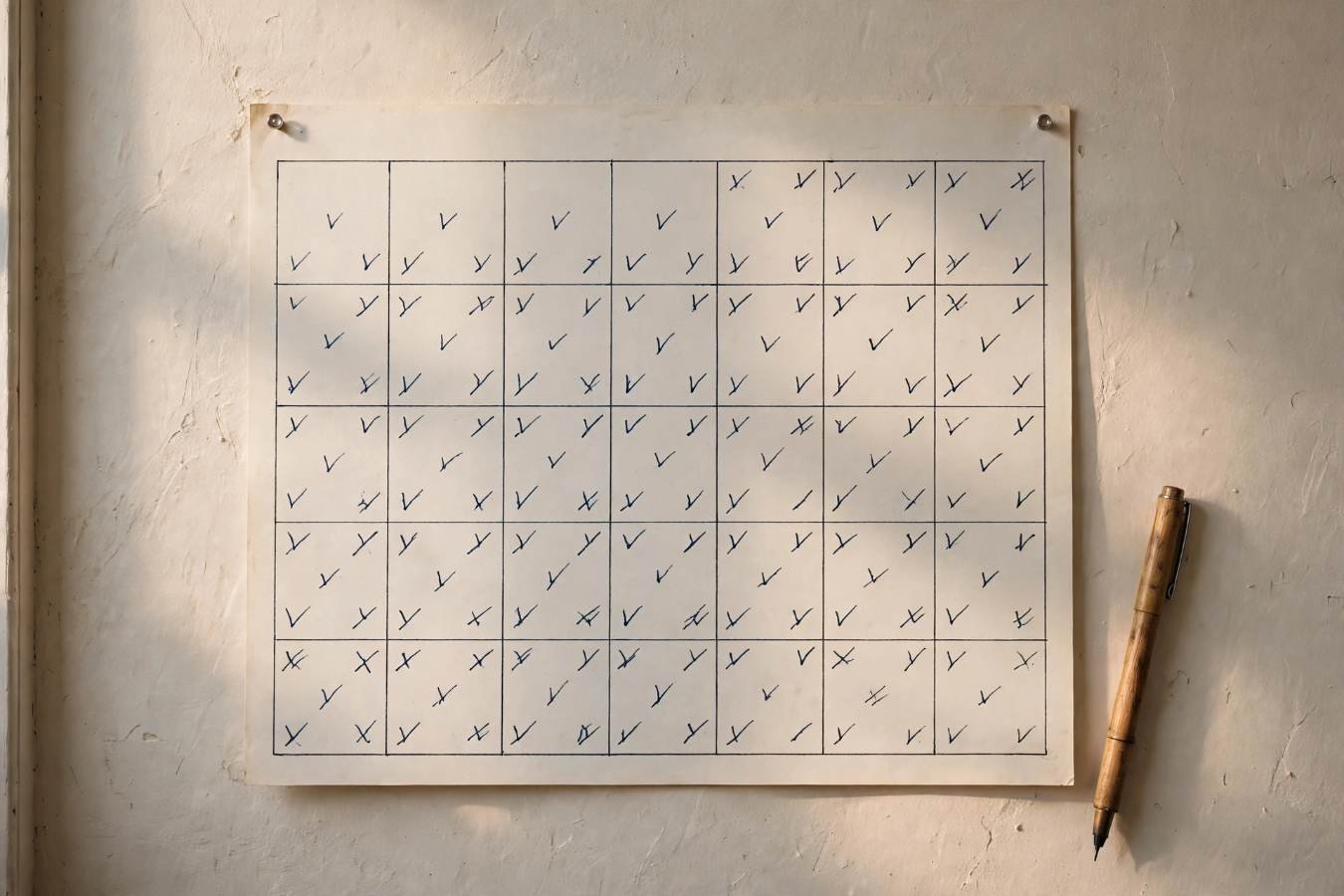
You do not need an app. A paper calendar on the wall with a mark for each day you did the habit is enough. The chain of marks shows progress and makes a gap easy to spot.
Track only one or two things. If tracking becomes a chore, drop it back to a single checkmark. The point is to keep the habit visible, not to build a dashboard.
Common mistakes
- Starting too big. Seven new habits on Monday usually means zero by Friday.
- Waiting to feel ready. The feeling often arrives after you start.
- Relying on willpower alone. Use cues, gear and schedules.
- Quitting after one miss. One skipped day barely matters. Return the next day.
- Tracking too much. Track one simple thing, like a checkmark on a calendar.

Why you can trust this guide
How we built it. We did not test these methods ourselves, and we do not claim personal results. The facts come from the UCL habit-formation study, the Gollwitzer and Sheeran 2006 meta-analysis, a later large synthesis of if-then plans, the 2016 ego depletion replication and the CDC activity guidelines.
Corrections. An earlier version of this page was written as personal stories we could not verify. We removed them and replaced them with sourced facts.
Limits. This is general information, not medical advice. Habit studies show averages, and individuals vary widely. Last checked: November 2026.
Questions people ask
Is discipline better than motivation?
For keeping a routine going, yes. Motivation helps you start, but discipline, meaning a routine and a plan, keeps you going when the feeling fades.
How long does it take to build a habit?
A UCL study found an average of 66 days, with a range from 18 to an estimated 254 days. It varies by person and by habit.
Does willpower run out?
The idea that willpower is a fuel tank is disputed. A large 2016 replication found almost no effect, so it is safer to rely on routines than on willpower.
What if I miss a day?
One missed day did not significantly slow habit formation in the UCL study. Just return the next day.
How do I stay disciplined when I am tired?
Use a smaller version of the habit. Five minutes counts. Also check your sleep, since tiredness makes everything harder.


Pingback: Best Ways to Reduce Stress Naturally - OptiFit Living – Smart Health & Fitness for Men Over 40