

Most adults over 40 should work toward at least 150 minutes of moderate aerobic activity each week, or 75 minutes of vigorous activity, plus muscle-strengthening activities on at least two days. Brisk walking can supply the aerobic component, while resistance exercises address strength. You can combine moderate and vigorous activity and spread your sessions around the week.
Deciding how much exercise per week suits you also requires a starting point. Someone returning after years of inactivity needs a different first week from someone already walking daily and lifting weights. Turning 40 does not create a separate exercise quota, and reaching the recommended amount is a goal to build toward. Smaller amounts still offer health benefits.
A useful routine should support the activities you want to keep doing, whether that means climbing stairs comfortably, carrying shopping, or enjoying long walks. Count what you currently do, consider how hard it feels, and identify the missing components. That gives you a more useful plan than choosing an arbitrary number of gym visits.
Understand how much exercise per week you need
The Physical Activity Guidelines for Americans distinguish aerobic volume from strengthening frequency. For substantial health benefits, adults should aim for 150–300 minutes of moderate aerobic activity, 75–150 minutes of vigorous activity, or an equivalent combination. Strengthening remains an additional component.

These recommendations describe different ways to organize activity. They do not require every adult to exercise for the same duration each day. The comparison below shows the main choices.
| Component | Weekly recommendation | Practical meaning |
|---|---|---|
| Moderate aerobic activity | 150–300 minutes | Activities such as brisk walking at an appropriate effort |
| Vigorous aerobic activity | 75–150 minutes | An alternative, or something to combine with moderate activity |
| Muscle strengthening | At least two days | Work all major muscle groups |
For aerobic accounting, one vigorous minute generally counts like two moderate minutes. For example, 90 moderate minutes plus 30 vigorous minutes provide 150 moderate-equivalent minutes, although the actual aerobic time is 120 minutes. Strength sessions still need separate attention.
Benefits begin below the recommended range, and additional activity can provide further benefits. The upper end is not a universal maximum. Your capacity, goals, and recovery determine whether increasing beyond your current routine makes sense.
Use effort to decide what counts
Aerobic exercise, often called cardio, involves sustained movement that raises breathing and heart rate. Walking, dancing, cycling, and swimming can contribute, but the effort matters. A relaxed stroll and a challenging uphill walk should not automatically receive identical treatment in your activity record.
The talk test provides a practical guide. At moderate intensity, you can talk but would struggle to sing; during vigorous activity, you can usually manage only a few words before pausing for breath. Relative effort also matters: the same pace may feel demanding to one person and comfortable to another.
A rating of perceived exertion offers another check. On the CDC’s scale from zero for sitting to ten for maximal effort, moderate effort is generally around five or six, while vigorous effort begins around seven or eight. These are guides to effort rather than targets to force yourself to reach.
Light movement still has value, even when it does not meet the aerobic intensity threshold. Likewise, a strength session does not automatically supply cardio minutes simply because you spend 30 minutes exercising. Rest between sets and the activity itself affect what qualifies.
For example, a hypothetical 40-minute outing might include 25 minutes at moderate effort and 15 minutes of easy movement. Record 25 qualifying aerobic minutes while recognizing the value of the whole outing. Effort matters as much as minutes when you work out how much exercise per week is enough.
Build strength for muscle and bone health
Maintaining muscle and strength supports physical function, including standing from a chair and carrying groceries. Age-related muscle loss, often discussed as sarcopenia, can make these tasks harder. Resistance training helps preserve and develop the capacity that everyday activities require.
Strength training can use body weight, bands, machines, or free weights. Aim to cover the major muscle groups rather than repeatedly training only your arms or abdomen. A practical full-body session can draw from these movement patterns:
- A squat or sit-to-stand movement.
- A hip hinge or suitable bridge.
- A pushing exercise.
- A pulling exercise.
- A carry or trunk-strengthening exercise.
Learn controlled technique and choose resistance that makes the final repetitions challenging without losing control. CDC guidance suggests beginning with at least one set of 8–12 repetitions per activity; additional sets can provide further benefits. An appropriate starting amount may be smaller when movement limitations or health conditions require adaptation.
Progressive overload means gradually increasing the challenge as your capacity improves. That might involve more resistance, another repetition, or a harder variation. Change something you can perform well rather than treating soreness as evidence of success.
Bone health adds another reason to vary activities. Weight-bearing exercise and resistance training load the skeleton in ways that swimming or cycling do not replicate. Someone with osteoporosis should obtain guidance on suitable loading and technique rather than adopting an unrestricted routine.
For example, a regular swimmer might already meet the aerobic target but have little resistance work in the week. Adding suitable strength sessions addresses that gap without requiring a wholesale replacement of an activity the person enjoys.
Include balance and mobility throughout the day
Balance training helps you control your position during standing and movement. Supported stance practice, controlled stepping, and tai chi are examples. Use stable support when needed, and seek appropriate guidance if falls or unsteadiness are concerns.

For adults aged 65 and older, balance becomes an explicit part of activity recommendations. WHO advises varied multicomponent activity emphasizing functional balance and strength on three or more days weekly, alongside the aerobic recommendations. In your 40s or 50s, choose balance practice according to your needs and abilities.
Mobility and flexibility work can help maintain usable movement for exercise and everyday tasks. Comfortable ankle, hip, or shoulder movements may address restrictions relevant to your routine. Stretching serves a different purpose from aerobic conditioning and does not replace strengthening.
Pay attention to sedentary behavior as well. A scheduled workout leaves many other waking hours available for movement. Walk during a phone call or get up between desk tasks, without assuming that one universal break interval or daily sitting limit applies to everyone.
Start with an amount you can repeat
Your first week should reflect what you can comfortably manage now. A hypothetical beginner who tolerates five minutes of walking might repeat that amount before adding a little duration. There is no requirement to reach 150 minutes immediately or follow a fixed percentage increase.
A simple progression process keeps the decision manageable:
- Choose an activity and starting amount you tolerate.
- Repeat it until it feels manageable.
- Increase one element, such as duration or resistance.
- Reassess symptoms, technique, and recovery.
Low-impact exercise can help when impact is uncomfortable, but low impact does not necessarily mean low intensity. Cycling or water-based exercise can still be demanding. Begin sessions with easier movement, and allow your response to guide the next increase.
If an illness, injury, or long interruption changes your capacity, reassess the starting point. Returning immediately to an old workload may create demands you are no longer accustomed to. Relevant health concerns deserve individual guidance before a generic progression is applied.
Progress may also mean repeating the same workload with steadier technique or less difficulty. If a small increase repeatedly leaves you struggling to complete ordinary activities afterward, scale it back and reassess before progressing again. A realistic answer to how much exercise per week you can sustain beats an ambitious plan you abandon.
Build a weekly schedule with clear totals
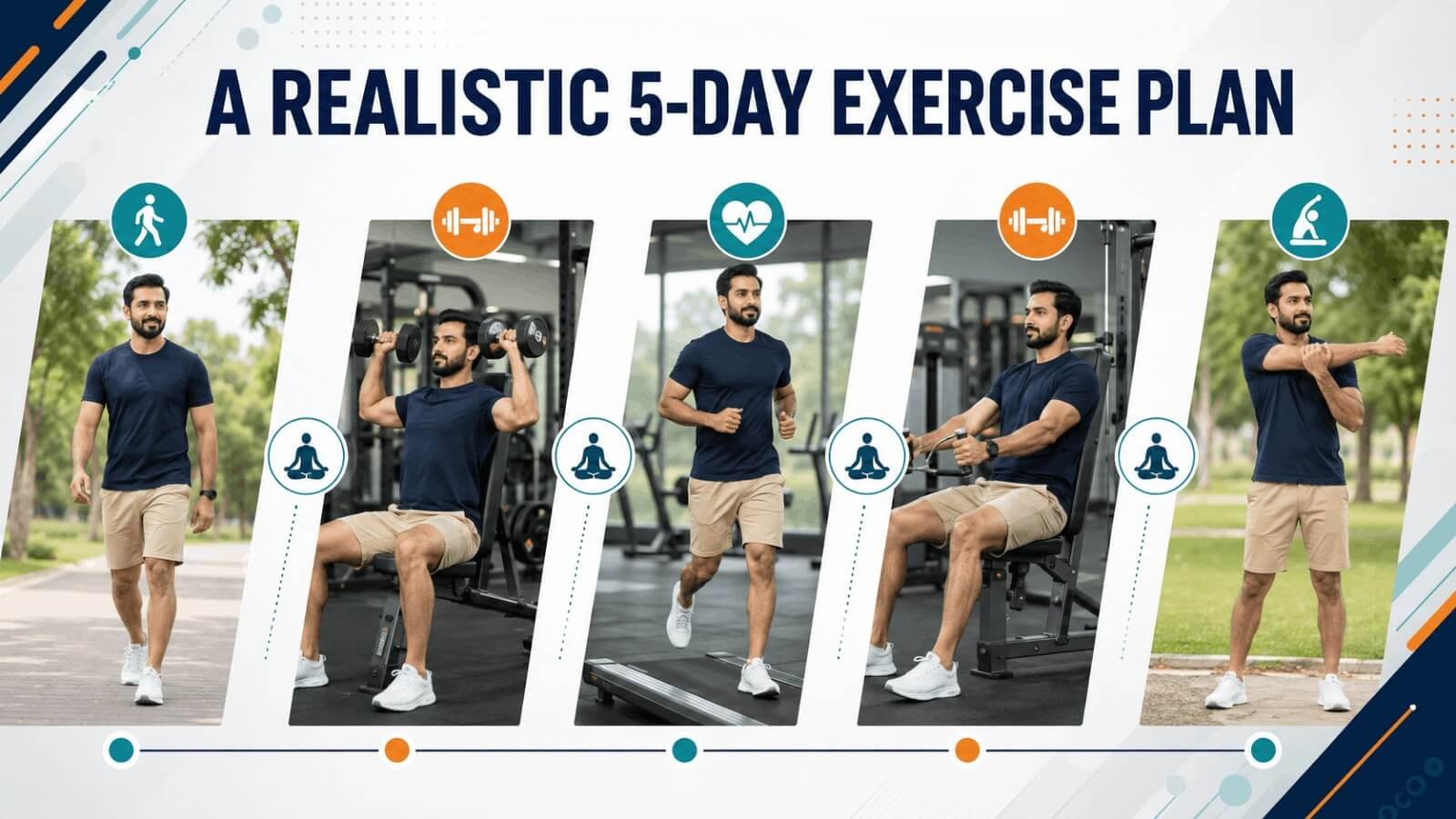
A weekly workout schedule should show both aerobic minutes and strengthening days. The hypothetical example below suits someone who has already developed tolerance for these activities. Its strength-session durations are illustrative, not official minimums.
| Day | Moderate aerobic activity | Other planned activity |
|---|---|---|
| Monday | 30-minute brisk walk | 25-minute full-body strength session |
| Tuesday | 30-minute cycle | Optional comfortable mobility work |
| Wednesday | None scheduled | Light movement or balance practice |
| Thursday | 30-minute brisk walk | 25-minute full-body strength session |
| Friday | 30-minute dance session | Optional balance practice |
| Saturday | 30-minute brisk walk | Comfortable mobility work if useful |
| Sunday | None scheduled | Rest or easy movement |
| Weekly total | 150 minutes | Two strength sessions totaling 50 minutes |
This schedule contains 200 planned minutes before optional activities or additional preparation time. Strength and cardio share two days, so meeting both recommendations does not require seven separate workout days. Ensure each aerobic activity reaches the intended effort rather than relying only on its name.
Short bouts of physical activity can make the schedule easier to follow. A 30-minute walk can become several shorter walks, provided the qualifying minutes add up. Current US guidance does not require an activity bout to last at least ten minutes before it counts.
For an older reader following WHO’s multicomponent guidance, balance and strength activities can be incorporated across additional days. Their placement should reflect ability and the purpose of the activity. Writing the plan down turns how much exercise per week into a simple, checkable total.
Use recovery to adjust the plan
Rest days and active recovery help organize effort around your response to training. An easier day can include comfortable movement; it need not mean complete inactivity. A practical starting arrangement is to separate demanding full-body strength sessions with an easier day.

Recovery needs depend on workload, training experience, health, and demands outside exercise. Poor sleep or persistent fatigue may justify reducing a session or holding your current workload. Mild muscle soreness can occur after unfamiliar activity, but you do not need soreness to demonstrate progress.
A weekend warrior pattern concentrates much of the week’s activity into one or two days. Observational research has associated concentrated and more evenly distributed activity with similarly lower cardiovascular risks. That finding does not prove that every schedule produces identical results or suits every beginner.
Choose a distribution you can tolerate and maintain. After a missed session, resume a sensible plan rather than suddenly doubling the next workout. A demanding week at work is a reason to adjust expectations, not to abandon the routine altogether. Recovery is part of how much exercise per week you can safely handle.
Adapt exercise to symptoms and health conditions
Exercise with chronic conditions often requires changes in activity choice, starting amount, or monitoring. Arthritis, cardiovascular disease, limited mobility, and osteoporosis can affect those decisions. A healthcare professional or physical therapist can help identify appropriate adaptations when symptoms or restrictions complicate the plan.

Medication matters too. Beta blockers slow heart rate, so a standard age-based heart-rate target may not suit someone taking them. Ask the prescribing clinician how to monitor effort; do not increase intensity simply to make a watch display an expected number.
During perimenopause and menopause, disrupted sleep or uncomfortable symptoms may affect scheduling and tolerance. Maintain attention to strength, bone health, and aerobic activity while adapting the routine. Regular activity supports your general health, although it has not been established as a reliable treatment for hot flashes.
Stop exercising and seek urgent medical help for concerning symptoms such as:
- Chest pain, pressure, or tightness.
- Fainting or severe dizziness.
- Extreme or unexpected breathlessness.
Persistent joint pain, swelling, or worsening symptoms also warrant assessment and adjustment. These should not be treated as evidence that a workout is effective.
Track progress beyond body weight
A useful activity record can be brief. Note your aerobic minutes and effort, strengthening days, and a relevant exercise measure, such as resistance used or controlled repetitions completed. Add a practical goal, perhaps climbing your usual stairs more comfortably.
Progress tracking should help you choose what to do next. If sessions feel manageable and recovery is good, consider a modest increase. If symptoms worsen or the plan repeatedly exceeds your available time, adjust the activity or schedule before adding more.
Body weight does not capture every exercise benefit. A step counter can encourage walking, but its total cannot show whether you trained your major muscle groups or practiced balance. Look at the components of your routine and the daily activities that are becoming easier.
For better adherence, connect activity to an existing opportunity, such as a lunchtime break, and prepare a fallback for bad weather. A shorter indoor session can preserve the habit when your usual plan becomes impractical.
Start by recording your current week and reserving two realistic opportunities for strengthening. Then choose one manageable improvement in aerobic activity. Build from a routine you can repeat, and adapt it when your health, capacity, or circumstances change. Tracking helps you judge whether your current amount of exercise per week is working.


Excellent article with helpful insights. The writing style is simple and engaging which makes learning easy. Thank you for creating such informative content that benefits readers looking for reliable health advice.
Pingback: Why Energy Levels Drop With Age - OptiFit Living – Smart Health & Fitness for Men Over 40