
Many people wonder, is it easier for men to lose weight than women. The answer is more complicated than a simple yes or no. Men and women have different body compositions, hormone profiles, and average muscle mass, which can influence how quickly their bodies respond to a calorie deficit.
Men often appear to lose weight faster when they begin a structured weight-loss program. However, this does not mean that losing weight is always easy for men. Age, diet, physical activity, sleep, stress, hormones, and starting body weight all affect individual results.
This is why many men ask, is it easier for men to lose weight, especially after the age of 40.
Understanding these differences can help men develop realistic expectations and choose healthier strategies for long-term weight management.
Is It Easier for Men to Lose Weight Than Women?
In many cases, men may lose weight faster during the early stages of a weight-loss program. One major reason is that men generally have a higher proportion of lean muscle mass and a lower average body-fat percentage than women.
So, is it easier for men to lose weight than women? Several biological and lifestyle factors can influence the answer.
Muscle tissue requires energy to maintain. As a result, a person with more lean muscle may have a higher resting metabolic rate and burn more calories throughout the day.
Men also tend to have larger bodies on average, which can increase their total daily energy expenditure. When a man creates a reasonable calorie deficit through diet and physical activity, the resulting weight loss can sometimes appear faster.Is it easier for men to lose weight when they have more muscle mass and higher daily energy needs? In many cases, these factors can contribute to faster initial progress.
However, these are population-level differences rather than guarantees for every individual. A woman with a higher starting weight or greater muscle mass may lose weight faster than a man with a lower activity level.
Therefore, is weight loss easier for men? In some circumstances, yes, especially at the beginning. But individual results depend on far more than sex alone.
Why Do Men Lose Weight Faster?

Several biological and lifestyle factors can contribute to faster initial weight loss in men.
Understanding these differences can explain why some men find it easier to lose weight at the beginning of a diet.This helps explain is it easier for men to lose weight during the early stages of a structured weight-loss plan.
Men Usually Have More Muscle Mass
One of the most important differences is body composition. Men typically have more lean muscle mass than women.
Muscle contributes to daily energy expenditure. Although muscle does not burn an enormous number of calories at rest, having more lean tissue can contribute to a higher overall calorie requirement.
This means a man may be able to eat more calories than a smaller person while still maintaining a calorie deficit.
Strength training can help preserve or build lean muscle during weight loss. Exercises such as squats, rows, presses, lunges, and other resistance movements can support muscle retention while reducing body fat.
Body Size Influences Calorie Needs
Larger bodies generally require more energy to perform basic functions and physical activities.
For example, walking, climbing stairs, or exercising may require more total energy for a heavier person than for someone who weighs considerably less.
This can make the initial calorie deficit larger when two people follow similar percentage-based dietary changes.
However, calorie needs decrease as body weight decreases. This is one reason why weight loss often slows after the first several weeks.
Men Often Have a Lower Average Body-Fat Percentage
Men and women naturally store body fat differently. Women generally need a higher essential body-fat level for normal physiological functions.
Men often begin a weight-loss program with a different body composition, which can affect how quickly changes appear on the scale and around the waist.
This does not mean that body fat is unhealthy for everyone. Healthy body-fat levels vary according to age, genetics, activity, and other factors.
Does Testosterone Affect Weight Loss?
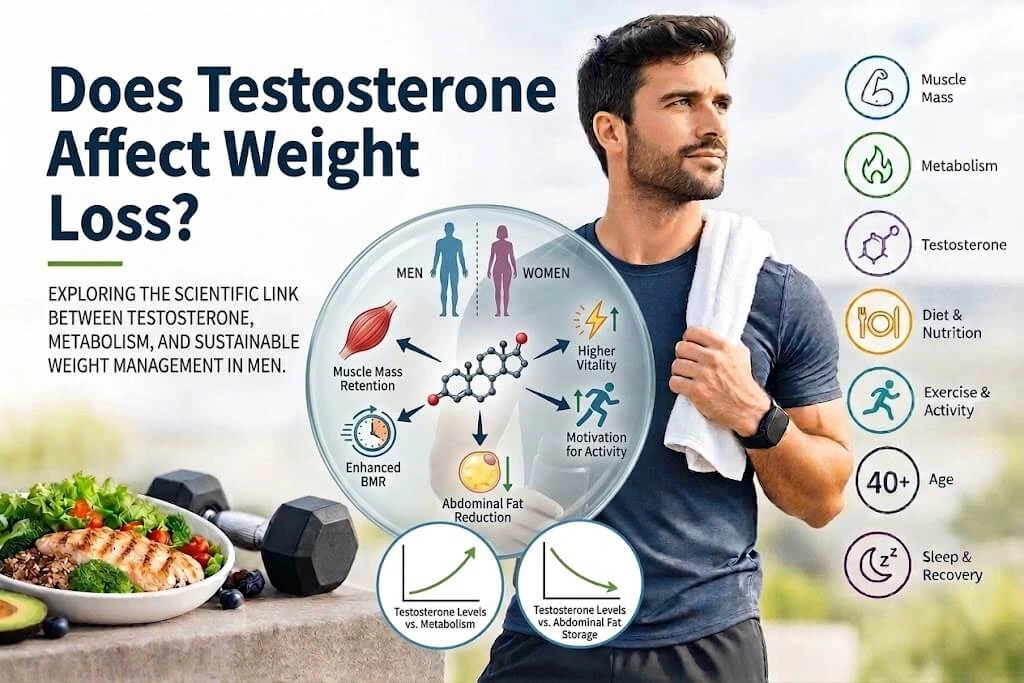
Testosterone is an important hormone involved in male health, muscle development, and body composition. Testosterone levels naturally change with age, and unusually low levels can be associated with changes in muscle mass, energy, and body composition.
However, testosterone should not be treated as a simple fat-burning hormone.
Men should not assume that taking testosterone or testosterone-boosting products will automatically produce healthy weight loss. Hormone treatment is appropriate only for specific medical situations and should be evaluated by a qualified healthcare professional.
For most men, sustainable fat loss still depends heavily on nutrition, physical activity, resistance training, adequate sleep, and consistent habits.
If a man experiences persistent fatigue, reduced strength, changes in sexual function, or unexplained changes in body composition, speaking with a healthcare professional is more appropriate than self-treating with supplements.
How Muscle Mass Supports Fat Loss
Muscle mass is especially important when discussing male metabolism and weight loss.
When people lose weight, the goal should not simply be to make the number on the scale smaller. Preserving lean muscle while reducing excess body fat can help improve body composition and physical function.
Resistance training is one of the most useful tools for maintaining muscle during a calorie deficit.
A balanced training routine may include:
- Squats or leg presses
- Lunges
- Push-ups or chest presses
- Rows
- Shoulder presses
- Pull-downs
- Core exercises
- Progressive resistance exercises
Men do not need to spend hours in the gym. A consistent strength-training routine performed several times per week can be valuable when combined with regular daily movement.
Is Weight Loss Harder for Men After 40?
For many men, losing weight after 40 can feel more difficult than it did in their twenties or thirties.Many men over 40 may also wonder, is it easier for men to lose weight after changing their diet and becoming more physically active?
This is not necessarily because the body suddenly stops burning calories. Instead, several lifestyle and physiological changes can happen at the same time.
Men may become less physically active because of work, family responsibilities, or changes in daily routines. Muscle mass can also gradually decline with age if resistance training and adequate nutrition are neglected.Many men over 40 also wonder, is it easier for men to lose weight when they become more active and improve their diet?
Sleep problems and chronic stress may further affect appetite, food choices, recovery, and physical activity.
These changes can make men’s weight loss after 40 more challenging.
The solution is not extreme dieting. A better approach is to build a routine around nutritious food, strength training, walking, adequate protein, quality sleep, and sustainable calorie control.
Can Men Lose Belly Fat Faster?
Belly fat is one of the most common concerns among men, particularly as they get older.
Men often tend to accumulate more fat around the abdominal area, while women may store more fat around the hips and thighs. Genetics, hormones, age, diet, activity levels, and overall body composition all influence fat distribution.The question of is it easier for men to lose weight is often connected to concerns about belly fat and body composition.
Unfortunately, it is not possible to choose exactly where the body loses fat first.
Doing hundreds of abdominal exercises will strengthen the abdominal muscles, but it will not specifically force the body to burn belly fat.
To reduce abdominal fat, men generally need to reduce overall body fat through a sustainable calorie deficit and regular physical activity.
Walking, resistance training, cardio, adequate protein, and a nutrient-dense diet can all support this process.
The Role of a Calorie Deficit
A calorie deficit is one of the fundamental principles of weight loss.
A calorie deficit occurs when the body uses more energy than it receives from food and beverages over time.
This does not mean men should drastically reduce their calorie intake. Very restrictive diets can be difficult to maintain and may increase hunger, fatigue, and the risk of losing lean muscle.Portion control can make it easier to manage calorie intake without completely eliminating the foods you enjoy. Learn more about losing weight with portion control
Instead, a moderate and sustainable reduction in calorie intake is generally more practical.
Men can create a calorie deficit by combining several habits:
- Eating appropriate portions
- Choosing minimally processed foods more often
- Increasing daily movement
- Performing resistance training
- Limiting high-calorie drinks
- Eating enough protein and fiber
- Monitoring progress over time
The goal should be consistent progress rather than the fastest possible result.
How Can Men Lose Weight Faster in a Healthy Way?
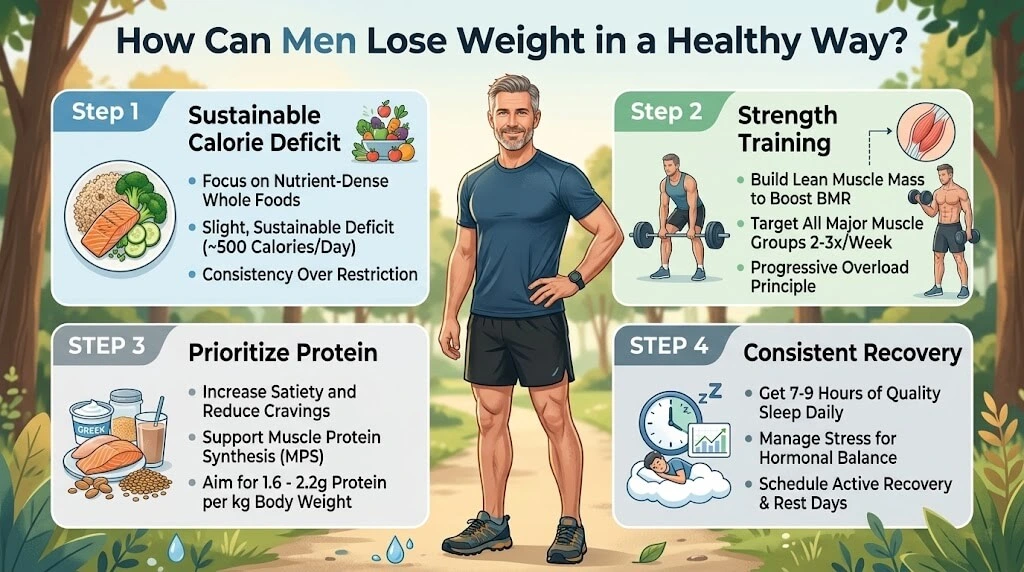
If your goal is how to lose weight for men, focus on habits that can realistically continue for months rather than looking for a quick solution.If you are wondering is it easier for men to lose weight, focus on sustainable habits rather than rapid weight-loss methods.
Starting the day with a balanced, protein-rich meal may also help support fullness and better food choices throughout the day. Explore these best breakfast ideas for weight loss
Eat Enough Protein
Protein can help support muscle maintenance during weight loss and may help with fullness.
Good protein sources include eggs, fish, poultry, lean meat, Greek yogurt, cottage cheese, beans, lentils, and other nutrient-rich foods.
The right amount depends on factors such as body size, activity level, health status, and individual goals.
Prioritize Strength Training
Strength training should be an important part of many men’s weight-loss programs.
Cardio can help increase energy expenditure and improve cardiovascular fitness, while resistance training helps support muscle strength and lean mass.
Combining both can provide a more balanced approach.
Walk More Every Day
Walking is simple, accessible, and easy to incorporate into most lifestyles.
You can increase daily movement by walking after meals, taking the stairs, parking farther away, or taking short movement breaks during work.
These small activities contribute to overall energy expenditure.
Choose High-Quality Foods
A healthy diet does not need to be complicated.
Build meals around vegetables, fruits, whole grains, legumes, lean proteins, nuts, seeds, and other nutrient-dense foods.
Highly processed foods can still fit into a balanced diet, but frequently eating foods that are high in calories and low in nutritional value can make calorie control more difficult.
Get Consistent Sleep
Sleep is often overlooked when people focus on weight loss.
Poor or insufficient sleep can affect appetite, food choices, mood, recovery, and daily activity.
Most adults should aim for a consistent sleep schedule and enough sleep to support overall health.
Why Weight Loss Slows Down
Many men become frustrated when the scale stops moving as quickly as it did during the first few weeks.
This is normal.
Early weight loss can include changes in stored carbohydrates and associated water, so the scale may move quickly at first. Later, weight loss often becomes slower as the body becomes lighter and calorie requirements change.
A plateau can also occur when portions gradually increase or daily activity decreases without the person realizing it.
Instead of immediately adopting a very restrictive diet, review food intake, activity, sleep, and consistency.
Progress can also be measured through waist circumference, clothing fit, strength, energy levels, and other health indicators rather than relying only on body weight.
Men and Women Have Different Weight-Loss Experiences
Research comparing men and women has found differences in body composition and weight-loss responses, but these differences should not be exaggerated.
Men may experience faster initial weight loss because they often have greater lean mass and higher energy requirements. Women may experience different changes because of hormonal factors, body composition, reproductive physiology, and other individual characteristics.
However, the basic principles of healthy weight management remain similar.
Both men and women benefit from appropriate calorie intake, nutritious foods, regular physical activity, resistance training, adequate sleep, and sustainable habits.
The most important factor is not whether men or women lose weight faster. It is whether an individual can maintain healthy behaviors over time.
When Should Men Talk to a Healthcare Professional?
Not every weight problem is caused by eating too much or exercising too little.
Certain medications, medical conditions, sleep disorders, hormonal problems, and other health factors can influence body weight.
Men should consider speaking with a healthcare professional if they experience unexplained weight gain, significant fatigue, major changes in appetite, persistent sleep problems, or difficulty losing weight despite consistent lifestyle changes.
A healthcare professional can evaluate the individual’s circumstances and determine whether further assessment is appropriate.
Men should also be cautious about products marketed as rapid fat burners or testosterone boosters. Supplements are not automatically safe or effective simply because they are sold as natural products.
Final Thoughts
So, is it easier for men to lose weight? In general, men may experience faster initial weight loss than women because they often have greater muscle mass, larger average body size, and different body-fat distribution.Ultimately, is it easier for men to lose weight depends on factors such as body composition, age, activity, nutrition, and consistency.
But faster initial progress does not mean that weight loss is effortless.
Age, metabolism, calorie intake, physical activity, sleep, stress, hormones, genetics, and consistency all influence results. For men over 40, maintaining muscle through strength training and eating enough protein can become especially important as part of a balanced approach to body composition.
The best way for men to lose weight is not an extreme diet or a quick-fix supplement. A sustainable calorie deficit, nutritious food, regular resistance training, daily movement, good sleep, and realistic expectations provide a much stronger foundation for long-term results.
Ultimately, healthy weight loss is not a race between men and women. The goal should be improving body composition, fitness, metabolic health, and overall well-being in a way that can be maintained for years.
For additional information about weight-loss treatment and healthcare options, readers can explore resources from St. Vincent’s Medical Center.